

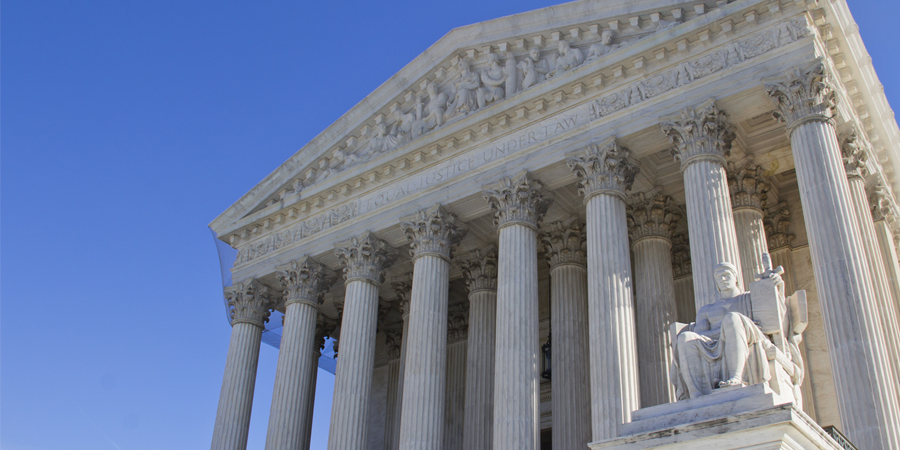
On March 31, 2026, the Supreme Court of the United States issued one decision:
Chiles v. Salazar, No. 24-539: This case addressed a First Amendment challenge to a Colorado law prohibiting licensed counselors from engaging in conversion therapy with minors. Kaley Chiles sought a preliminary injunction, raising a First Amendment challenge to the law as applied to her talk therapy. The district court and Tenth Circuit denied Chiles’ request, holding that the Colorado law regulated speech only incidentally to professional conduct. The lower courts found the law triggered “rational basis” review under the First Amendment, and Colorado sufficiently showed the law was rationally related to a legitimate government interest. In 8-1 decision authored by Justice Gorsuch, the Court reversed the Tenth Circuit and remanded the case, finding Colorado’s law regulates speech based on viewpoint, and the lower courts erred by failing to apply sufficiently rigorous First Amendment scrutiny. The majority held that as applied to Chiles, Colorado’s law regulates the content of her speech and goes further to prescribe what views she may and may not express, discriminating on the basis of viewpoint because it permits her to express acceptance and support for clients exploring their identity or undergoing gender transition, but forbids her from saying anything that attempts to change a client’s sexual orientation or gender identity. The majority held that laws “like Colorado’s, which suppress speech based on viewpoint, represent an egregious assault” on “each American[’s] inalienable right to speak his mind and a faith in the free marketplace of ideas as the best means for finding truth.” Justice Kagan concurred, joined by Justice Sotomayor, stating that the Colorado law would raise a “different and more difficult question” if the law were content-based but viewpoint-neutral. Justice Jackson dissented, finding the majority’s ruling “opens a dangerous can of worms” and threatens to impair States’ ability to regulate the provision of medical care.
View the Court's decision.
On March 30, 2026, the Supreme Court of the United States granted certiorari in one case:
Younge v. Fulton Judicial Circuit District Attorney’s Office, Georgia, No. 25-352: This case arises from a federal civil rights lawsuit under the Civil Rights Act of 1964 (the “Act”). The defendant did not attempt to rely on a statutory exemption to the Act in its answer to the complaint, but instead first relied on the exemption when moving for summary judgment. The question presented is: Whether, where a defendant has filed an answer without pleading an affirmative defense, the defendant may nonetheless assert that affirmative defense as the basis for a summary judgment motion, without amending or seeking to amend its answer to plead that affirmative defense, and whether a defendant may do so even if an amendment adding that affirmative defense would be barred by Federal Rule of Civil Procedure 16(b)(4).