Trade Dress
Protecting the Pint: Rebel Creamery Appeals Trade Dress Judgment
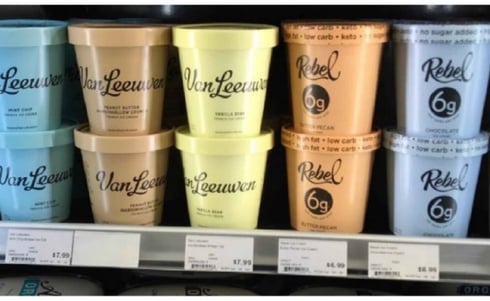
(Source: Memorandum & Order, Van Leeuwen Ice Cream LLC v. Rebel Creamery LLC) It is back out of the freezer and into court for Van Leeuwen Ice Cream LLC v. Rebel Creamery LLC, after Rebel submitted an appeal to the United States Court of Appeals for the Second Circuit and filed for Chapter 11 bankruptcy protection. In July 2026, Brooklyn-based ice cream company Van Leeuwen secured an injunction and $23,785,000 judgment for trade dress infringement against Utah-based Rebel Creamery in the United States District Court for the Eastern District of New York. The subject of dispute: ice cream pint packaging. Trade dress encompasses the overall design and appearance that makes a product identifiable to consumers. Van Leeuwen ascribed the relevant trade dress to its “classic dairy line” — a set of thirty-seven ice cream flavors, excluding limited edition and vegan flavors — defining it by reference to four “elements”: (a) cardboard monochromatic pints with matching monochromatic lids; (b) use of a primarily pastel color palette and/or pastel tinted hues; (c) black script typeface lettering with an exaggerated capital letter appearing across the front of the ice cream pint with additional descriptive writing in black lettering; and (d) an overall minimalistic design aesthetic. Van Leeuwen sued Rebel for trade dress infringement and other related claims under federal and New York law. The trial court found the evidence “left no doubt that Rebel infringed and diluted Van Leeuwen’s trade dress and did so intentionally.” In a trade dress infringement case, the plaintiff must define its claimed trade dress with specificity and demonstrate a “consistent overall look” across the product line. The court determined Van Leeuwen satisfied both requirements. Its asserted trade dress elements were sufficiently objective and precisely identified to put Rebel on notice of the claimed trade dress, and the classic dairy line maintained “a recognizable and consistent look.” Rebel argued that Van Leeuwen deployed its trade dress inconsistently, pointing to several classic dairy flavors that were not sold in pastel-colored pints, including Mint Chip, Black Cherry Chip, Lemon Poppy Seed Muffin, and Raspberry Layer Cake. The court was unpersuaded. It noted that the non-pastel containers represented only a small portion of the classic dairy line and were not sold simultaneously. Further, the green Mint Chip pint was the product of a mistake that was quickly corrected to the original pastel color, and the lemon and raspberry flavors had since been discontinued. Because Van Leeuwen defined its trade dress as “primarily” pastel, the court concluded these outliers did not undermine the product line’s overall consistency. Rebel’s argument that Van Leeuwen’s use of non-pastel and non-monochromatic color schemes in its limited-edition flavors also failed because those pints fell outside the specified scope of the classic dairy line. In determining a likelihood of confusion between the sparring scoops, the court emphasized the pint packaging’s high degree of similarity, as both containers used pastel colors, were monochromatic from the lid to the pint, used black script font for their logo, with Van Leeuwen’s “L” and Rebel’s “R” extending under the rest of the mark name, and favored minimalistic surface area designs. The only distinctions between Van Leeuwen and Rebel’s packaging were Rebel’s keto elements: the black circle stating the number of net carbs or net grams of sugar, and the language on the lid stating “keto, full fat, lactose free.” The court was also persuaded by Van Leeuwen’s argument that consumers and grocery store employees experienced actual confusion. While actual confusion is not required to establish likelihood of confusion, it is particularly compelling when present. Van Leeuwen introduced anecdotal evidence from a confused consumer who wrote to Rebel reporting that her husband accidentally purchased Rebel ice cream instead of Van Leeuwen when she sent him to the store. The company also introduced evidence of employee confusion revealing that grocery store employees were mistakenly applying Rebel price tags to Van Leeuwen pints and intermingling the products in freezer displays. The cherry on top of Van Leeuwen’s actual confusion argument was a “Squirt” survey conducted by its expert, which yielded a net confusion rate of 34.3%. In a Squirt survey, participants are shown an array of trademarks or trade dresses and asked questions about whether they believe the items in question originate from the same corporate source. In Van Leeuwan’s survey, participants viewed Rebel’s packaging alongside Van Leeuwen and several other brands before answering questions about perceived connections between Rebel and a designated brand. Rebel challenged the survey’s methodology, but the court ultimately found it reliable, citing a proper participant pool, sound controls, and appropriate open-ended questioning. In trademark cases, a 15% net confusion rate is generally considered sufficient to demonstrate actual confusion. Van Leeuwen’s 34.3% result more than doubled that benchmark, adding significant weight to its infringement claim. Van Leeuwen sought a permanent injunction requiring redesign and an accounting of Rebel’s profits and an award of $36.4 million. In the end, the trial court granted the injunction but reduced the award by 33% to $23,785,000 to account for Rebel sales attributable to demand for keto and better-for-you ice cream instead of product packaging. Despite the judgment, this legal sundae is not over yet. Rebel filed its appeal on August 12, 2026, then filed for bankruptcy two days later on August 14, 2026. Subscribe to the TMCA Blog to get the scoop on future case updates.
September 18, 2026
by Alexandra Holbus and Maia Songer
Trade Dress
Ninth Circuit Revives Trademark Dispute After Monster Energy Refused to Throw in the Towel
The Ninth Circuit recently revived Monster Energy Company’s (“Monster Energy”) trademark and trade dress dispute against a company that markets camping equipment under the mark 4MONSTER. Monster Energy owns the well-known MONSTER word mark, related “M Claw” logos, and the green-and-black trade dress used with these trademarks (the “MONSTER Marks”). The MONSTER Marks are widely recognized in connection with Monster Energy’s popular energy drinks but are also used by Monster Energy and its licensees on a variety of merchandise products including t-shirts and other apparel and, most importantly for present purposes, bags and towels. Defendant 4Monster markets textile-based camping products including towels, backpacks, blankets and robes. It uses the word mark 4MONSTER in connection with these products and the 4MONSTER mark appears in a variety of colors on these products, including green-and-black, blue, yellow, purple, and orange. Monster Energy sued 4Monster in the U.S. District Court for the Southern District of California for trademark infringement, trade dress infringement, and related unfair competition claims. Both parties moved for summary judgment on all claims and the District Court granted summary judgment in favor of 4Monster, finding no reasonable jury could find a likelihood of confusion. On appeal, the Ninth Circuit reversed and remanded, finding that several of the likelihood of confusion factors could weigh in Monster Energy’s favor. It was undisputed that the MONSTER Marks are both conceptually and commercially strong when used in connection with energy drinks. However, the District Court found that Monster Energy failed to show any evidence of commercial strength in connection with non-beverage-related items, such as merchandise. This was because Monster Energy’s evidence of marketing expenditures, revenues, and surveys in support of mark strength all related to the MONSTER brand as a whole. However, Monster Energy did not introduce any evidence specific to its use of MONSTER for merchandise. Monster Energy’s evidence was also vague as to what branded merchandise items are actually sold to consumers, rather than distributed as promotional items. The District Court found this vague evidence to be unhelpful in showing the strength of the MONSTER Marks. It also found that it suggested that the parties’ goods are in fact not related or competing because 4Monster’s products are sold direct to consumers online whereas it remained unclear where or how Monster Energy’s merchandise is sold. Ultimately, the District Court found that all but one of the confusion factors favored 4Monster and granted summary judgment. Undeterred, Monster Energy appealed to the Ninth Circuit, which disagreed. It first noted that the MONSTER Marks are conceptually distinctive and entitled to the highest degree of trademark protection. As for commercial strength, the widespread distribution of Monster Energy’s merchandise, whether sold or otherwise, is sufficient for a reasonable juror to find that the MONSTER Marks have marketplace recognition in connection with merchandise. The Ninth Circuit also held that a jury could find that the parties’ goods are similar or complementary. It noted that MONSTER-branded towels and bags, and 4MONSTER-branded towels and backpacks are similar in use and function. MONSTER energy drinks could be complementary to 4MONSTER-branded towels and backpacks because Monster Energy markets its energy drinks as “adjacent to extreme sports and outdoor adventure activities.” Compounding the likelihood of confusion was the fact that the parties’ goods are low-cost, such that consumers are unlikely to exercise a high degree of care in their purchasing decisions. The Ninth Circuit found that other likelihood of confusion factors, including the marketing channels used by the parties and 4Monster’s intent in selecting the mark, do not favor a likelihood of confusion. Still, enough of the factors weighed in Monster Energy’s favor and summary judgment was inappropriate. Monster Energy will now have another chance to pursue its claims in the District Court. We’ll be monitoring this case.
November 14, 2025
by Connor J. Hansen
Trade Dress
Take a Bite Out of This: Smuckers is Claiming Exclusive Rights to its Version of the Peanut Butter and Jelly Sandwich
We all have childhood memories of it: the sweet tang of fruit jelly mixed with the salty crunch of rich peanut butter, sandwiched between two pieces of soft sliced bread. Maybe you preferred it with the crusts on, cut along the diagonal, or with no crusts at all, cut into four square servings. Or maybe you enjoyed a circular, crimped version packaged in plastic wrap and tucked conveniently in our lunch box. In whichever preparation you favor the classic PB&J sandwich, various forms of it are, and have been, a lunchtime staple of schoolkids for generations. I, myself, am a child of the ‘90s, and vividly remember my peers enjoying a particular version of a thawed, disc-shaped, crustless PB&J in the school cafeteria. These sandwiches—produced by J.M. Smuckers Company (“Smuckers”) and branded under the UNCRUSTABLES trademark—were first launched into the U.S. market in 1996 and have maintained their popularity ever since. In the last two decades, Smuckers has invested billions of dollars to develop and grow the goodwill and branding associated with these peculiarly shaped sandwiches. Not only does Smuckers own a number of federal U.S. trademark registrations for the UNCRUSTABLES name and stylized logo covering sandwiches and other related food goods, but it also claims rights in the distinctive style and design of the product itself. According to Smuckers, it has source identifying trademark rights in and to “the design of a round crustless sandwich, inclusive of the configuration in a round pie-like shape with distinct peripheral undulated crimping,” as well as packaging picture representations of “a round crustless sandwich in whole and with a bite taken out of it showing filling on the inside” of the sandwich. In short, Smuckers claims exclusive rights in the trade dress of its UNCRUSTABLE sandwiches. “Trade dress” constitutes a form of trademark right wherein a “symbol or device” serves a source identifying function—consumers view this symbol or device and associate it with the source of the corresponding goods, and not just the goods themselves. See Trademark Manual of Examining Procedure, Section 1202.02 (citing 15 U.S.C. § 1052). Originally, trade dress protection only protected the packaging or dressing of a product (the most famous example for which being the Coca-Cola bottle), but in recent years, such protection has expanded to encompass the design of the product itself, as well as its color or flavor. See id. The product design is defined as the “total image and overall appearance” of the product, as measured by a totality of its elements, including its features like size, shape, color, texture, or corresponding graphics. See id. (citing Two Pesos, Inc. v. Taco Cabana, Inc., 505 U.S. 763, 764 n.1, 23 USPQ2d 1081, 1082 n.1 (1992)). But protecting trade dress as trademark rights is tricky and represents a high bar because the claimed trade dress must be both non-functional (e.g., not essential to the use or purpose of the article) and distinctive. And making this protection more difficult to garner, in its 2000 decision in Wal-Mart Stores v. Samara Bros., the U.S. Supreme Court held that, by default, product design is not inherently distinctive, and therefore, requires secondary meaning in order to garner any form of trademark rights and a federal trademark registration. Proving that trade dress has acquired the sufficient secondary meaning to become distinctive is no small feat. Under Section 2(f) of the Lanham Act, 15 U.S.C. § 1052(f), secondary meaning is established through substantially exclusive and continuous use of the trade dress as a trademark by the owner in commerce for at least five years. In practice, the owner of the product design must prove that, by virtue of its exclusive, continuous use of the product design in the market, consumers have come to recognize that particular product design as a source identifier of the goods, and not just a design of the goods themselves. And Smuckers did just that with its UNCRUSTABLE sandwich product design. In 2002, Smuckers successfully registered with the U.S. Patent and Trademark Office (“USPTO”) the trade dress for its sandwich, the product design for which is seen below (see U.S. Reg. No. 2623577): It also owns, among many others, U.S. Reg. No. 5,941,408 for a 2-D depiction of its UNCRUSTABLE sandwich with a bite out of it, seen below, that Smuckers says it uses in many forms as a pictorial representation on the UNCRUSTABLE product packaging: Given Smuckers’ substantial investment in the intellectual property of its UNCRUSTABLES-branded product, particularly its trade dress, it has a vested interest in protecting the exclusivity of that product design as a brand, and not just as a food preparation style. And it has done just that. On October 13, 2025, in the Northern District of Ohio, Smuckers filed a lawsuit against Trader Joe’s Company (“Trader Joe’s”) regarding Trader Joe’s own sale of a “crustless, peanut butter & strawberry jam sandwich” product. See Case No. 5:25-cv-02181. According to Smuckers’ complaint, Trader Joe’s product is a “round, crustless sandwich with a crimped edge that [Trader Joe’s] is marketing with a bite taken out of it on the packaging that mimics” Smuckers’ UNCRUSTABLE products. The subject Trader Joe’s product is shown below: Notably, Trader Joe’s is not using the UNCRUSTABLE trademark, or any brand confusingly similar to the same, and thus, Smuckers’ claims are focused only on the product design of Trader Joe’s sandwiches. In addition to claims of federal and common law trademark infringement and others, Smuckers’ complaint claims its UNCRUSTABLE trade dress is famous, and Trader Joe’s use of a similar product design is diluting the strength of Smuckers’ rights. The fame of its trade dress is yet another high bar Smuckers will have to prove in order to succeed in its claims against Trader Joe’s. There is no question that Smuckers has spent a tremendous amount of time and money in protecting this trade dress. But if this case moves forward, Smuckers will face a test it did not have to at the USPTO. During the prosecution and examination of its trade dress application—importantly, an ex parte proceeding—Smuckers submitted promotional materials, sales volume, advertising expenditures, and media mentions to support its claim that the UNCRUSTABLES trade dress had acquired the requisite secondary meaning. The USPTO accepted this evidence and granted Smuckers its sought-after registration. But now Smuckers must prove consumers are likely to be confused by Trader Joe’s version of the crimped PB&J. This might be a challenge. After all, at the point-of-sale, consumers will see the Trader Joe’s sandwiches covered in Trader Joe’s wrapping, all within the context of a purchasing environment where Trader Joe’s branded products are ubiquitous. Perhaps Smuckers will have to consider a post-sale theory of confusion where students and lunchroom attendants are queried as to whether they believe Trader Joe’s sandwiches are really UNCRUSTABLES. Smuckers may have spent billions in protecting its trade dress, but whether that money has translated into consumer perception such that confusion is likely has yet to be seen, and may soon be put to the test.
November 4, 2025
by Lindsey Sadler

Trade Dress
Labubu and La-No-No: Navigating Trade Dress in Plush Toys
Most companies would love to have their product become a viral sensation, but in the age of viral media and “internet dupes,” companies are forced to fire on all cylinders to successfully secure and defend the intellectual property rights when one of their products takes off unexpectedly. Just look at the newest internet-sensation plush toy: Labubu. Labubus are fuzzy, monster-like toys that have gained popularity among a variety of ages, finding a large fanbase on TikTok. These toys are the creation of Kasing Lung, the illustrative artist of the book series, “The Monsters.” Following the publication of this series, Lung released a toy version of the “monsters.” And in 2019, Lung teamed up with POP MART, a Chinese toy company, to take this toy line to the next level. POP MART did exactly that, although its success did not occur overnight. This new monster collection toy line received the name—“Labubu.” Despite Labubu’s launch in 2019, POP MART did not seek trademark rights until after the beginning of the toy’s viral success in 2024. And even then, POP MART filed only for the registered word mark “Labubu.” Since 2024 Labubu replicas have been popping up all over the internet, including dupes touting the name "Lafufu." Obtaining registered trademarks for these internet sensation toys pose challenges, especially when filing after going viral, like POP MART. While there are well-established rules in U.S. trademark law that the first to use the mark in commerce has trademark priority, this is does not completely curtail the filing frenzy. Not to mention, securing trademark rights early can help companies enforce their rights after the inevitable “dupes” surge the market. Labubu 3-D Printed Look-Alike One option for POP MART may be to assert trade dress claims. Squishmallows, a different internet-viral plush toy, have also faced widespread copyright and trademark issues from internet dupes. Squishmallow’s manufacturer, Kelly Toys Holdings, filed for trademark protection of the word mark “Squishmallow” in 2018, several years before the peak of its internet fame in 2023. However, like POP MART, Kelly Toys did not file for trade dress protection for its plush, egg-shaped line of toys. But with its rise in internet fame (and therefore dupes), Kelly Toys has taken an active stance in the enforcement of its trade dress rights. In February 2024, Kelly Toy sued Build-A-Bear Workshop, Inc. in Kelly Toys Holdings, LLC v. Build-A-Bear Workshop, Inc., 2:24-cv-01169, alleging that Build-a-Bear’s new line of plush toys had the same distinctive trade dress as Squishmallows. For a trade dress infringement claim in California to succeed, the plaintiff must “clearly articulate” its claim to give the defendant adequate notice of the total image, design, and appearance of the trade dress. In its complaint, Kelly Toys described the Squishmallow trade dress to include: egg-shaped plush toys depicting various characters, simplified Asian style Kawaii faces with repeating rounded graphics, embroidered facial features, short-pile velvety velour-like fur, and a squeezable marshmallow feel. Build-A-Bear moved to dismiss the complaint, arguing that the Plaintiff’s description of its trade dress was overbroad, vague, and included “generic and functional features commonly found in plush products.” However, the California Central District Court disagreed with Build-A-Bear, concluding that the focus of a trade-dress analysis is not about the individual features but rather the “overall visual impression that the combination and arrangement [] those elements create.” The court also disagreed with Build-A-Bear’s argument that to assert a protectable trade dress, Kelly Toys must allege a trade dress that is “common to all items in the series or line.” Build-A-Bear argued that because Kelly Toys’s trade dress description could not apply to its over 3,000 product line of Squishmallows, it could assert no trade dress whatsoever. The court held that this sort of fact-intensive, product-by-product analysis is inappropriate at the pleading stage, but the court noted that it could revisit the consistent-overall-look test at the summary judgment stage with a developed factual record. A trade dress claim by Labubu may face similar opposition. Like the Squishmallows in Kelly Toys, Labubu’s signature features—its expressive eyes, oversized head, and mischievous expression—taken together may create a recognizable aesthetic associated with the Labubu brand. However, also like Squishmallow’s range of plushies, there are distinctive features across the iterations of Labubu’s expanding product line. POP MART has already taken some legal action. Earlier this year, a Chinese court ruled in favor of POP MART, finding the sale of 3D printed Labubu duplicates to be a violation of Chinese copyright laws. Time will tell if POP MART uses other tools to protect Labubu products and whether they can do so before the market moves on to the next fad.
July 17, 2025
by Case Collard and Kendall Lilly
Trade Dress
Wavy Baby’s Shoes Not Entitled to Special First Amendment Protections
40 years ago, I was the new kid in 6th grade – truly a terrible age in a young girl’s life to try and “fit in” at a new elementary school in a small town. But, one of my best memories from that year was procuring my first pair of blue and white checkered Vans shoes. Not many people had them where I lived, though the shoes had been around for nearly 20 years at that point. Even then I knew and appreciated the beauty of unique shoes, so imagine my delight in seeing a resurgence in the popularity of the shoes again in the marketplace the last handful of years, and the ability to add to my personal collection of awesome shoes. Vans are undoubtedly iconic. The shoes have been available since 1966, with a broad customer base, including skateboarders, BMX bike riders, celebrities, and people that just appreciate unique and functional shoes. Of its shoes, the “Old Skool” style is arguably instantly recognizable: The staple in the closet of any owner of Vans shoes comes with a price tag of about $60 for a pair of shoes, and Vans has worked with multiple artists and celebrities to create and sell special edition versions of its shoes. Special patterns, platforms, hi-tops, mid-tops . . . a marketable commitment to innovation that reaches the broadest base of consumers. MSCHF Product Studio, Inc. is a Brooklyn-based art collective with a mission to “use artwork to start a conversation about consumer culture . . . by participating in consumer culture.” MSCHF created the “Wavy Baby” sneaker purportedly as a parody of the Old Skool shoes, to serve as social commentary about the inherent consumerism in “sneakerhead culture.” MSCHF co-Chief Creative Officer explained that “The Wavy Baby concept started with a Vans Old Skool sneaker” “because no other shoe embodies the dichotomies between ‘niche and mass taste, functional and trendy, utilitarian and frivolous’ as perfectly as the Old Skool.” As a starting point, MSCHF took an image of a Vans Old Skool skate shoe, and then used a digital filter tool to transform the shoe “into the modern, wobbly, and unbalanced realities.” MSCHF then collaborated with musical artist Tyga as part of a marketing campaign in connection with releasing a limited run of the sneakers for purchase by consumers, with a hefty price tag of $220 per pair. Of course, Vans quickly caught wind of the campaign and, pending release of the Wavy Baby sneakers for purchase, sent cease and desist letters to both Tyga and to MSCHF. MSCHF nonetheless continued to promote its shoe campaign and launched a one-hour window sales promotion for consumers to purchase 4,306 pairs of Wavy Baby shoes, which sold out. (Here’s the math: $220 multiplied by 4,306 is $947,320) Not surprisingly, Vans filed suit in the U.S. District Court for the Eastern District of New York, including a federal claim of trademark infringement under the Lanham Act. It also filed a Motion for a Temporary Restraining Order and Preliminary Injunction, which was granted by the district court because “Vans had shown a significant danger of consumer confusion” and also that it would suffer irreparable harm without injunctive relief. Notably, the district court rejected MSCHF’s argument that its parodic work of artistic expression was subject to special First Amendment protections rather than the traditional likelihood of confusion test. As the court put it, while courts have “considerable leeway to parodists whose expressive works aim their parodic commentary at a trademark or a trademark product . . . they also have not hesitated to prevent a manufacturer from using an alleged parody of a competitor’s mark to sell a competing product.” In other words, a successful parody should simultaneously convey that it is not the original and is a parody. Given Vans’ significant collaborative efforts with artists and its visibility in the marketplace, as well as the manner in which MSCHF ran its advertising campaign and its sale of actual Wavy Baby shoes to consumers, the court concluded that “the Wavy Baby shoes on their face did not clearly indicate to the ordinary observer that MSCHF is not connected in any way with the owner of the target trademark.” MSCHF then appealed the decision to the U.S. Court of Appeals for the Second Circuit, which affirmed that MSCHF is not entitled to special First Amendment protections. In doing so, the court took into account the recent Supreme Court decision in the Jack Daniel’s Properties, Inc. v. VIP Products LLC case and the Rogers v. Grimaldi case, both of which provide guidance as to whether an expressive work is entitled to heightened First Amendment scrutiny. Where an artistic expression is in play, a trademark infringement claim may be more narrowly applied. The Second Circuit held in Rogers that the Lanham Act should not apply to “artistic works” as long as the defendant’s use of the mark is (1) artistically relevant to the work, and (2) not “explicitly misleading” as to the source or content of the work. The Supreme Court’s decision in Jack Daniel’s also clarifies when the Rogers test and its heightened First Amendment protections DO NOT apply – i.e., when the allegedly infringing mark is used as a source identifier for its own goods. The Second Circuit held that the Supreme Court’s Jack Daniel’s decision “forecloses MSCHF’s argument that Wavy Baby’s parodic message merits higher First Amendment scrutiny under Rogers” because the Wavy Baby shoes at issue were used “at least in part” for source identification. MSCHF made use of the Old Skool trademarks and trade dress, it included its own branding on the Wavy Baby sneakers, and it failed to include a disclaimer disassociating it from Vans or Old Skool shoes. Ultimately, MSCHF sold nearly $1,000,000 in shoes through the benefit of the good will that Vans owns in the Old Skool shoes and its distinctive branding. This use of Vans’ trademarks as a source-identifier to sell its Wavy Baby shoes to the general public works directly against parody protection under Rogers. “ . . . if a parodic use of protected marks and trade dress leaves confusion as to the source of the product, the parody has not “succeeded” for purposes of the Lanham Act, and the infringement is unlawful.” MSCHF’s ostensible mission is to “use artwork to start a conversation about consumer culture . . . by participating in consumer culture.” It certainly didn’t work out very well for them here.
February 8, 2024
by Cathy Dahl
Trade Dress
In-N-Out Trade Dress Dispute Part III: To Squirt, or Not to Squirt?
Welcome to the final chapter of our Burger War Trilogy. In our earlier installments, Part I and Part II, we discussed the secondary meaning surveys proffered by both parties in this trade dress dispute. We now turn to In-N-Out’s likelihood of confusion study in this case as it provides the perfect opportunity to discuss a decision that trial counsel and their consumer survey experts routinely grapple with: To Squirt, or Not to Squirt, that is the question. Before discussing that question in the context of this dispute, a slight detour is in order. Broadly speaking, there are two types of generally accepted consumer survey formats when testing for “likelihood of confusion” in trade dress and trademark cases. There is the “Eveready” format, and the “Squirt” format. The Eveready format has been referred to as the “gold standard” when the senior user’s trade dress or trademark is a commercially strong mark. In an Eveready survey design, the senior user’s mark or trade dress is not shown to survey respondents as part of the survey and is assumed to be known to most of the relevant consumers and thus already in mind. Instead, respondents are just shown the (allegedly) offending trademark or trade dress and asked a series of questions regarding who they believe makes or puts out the product or service at issue or who the product or service might be affiliated with. By contrast, the Squirt design shows both parties’ trademarks (either juxtaposed together at once or separately seriatim) and asks a series of questions as to whether the survey respondents believe there is an affiliation or connection between the products or the companies that put them out. Neither format is necessarily a panacea in all cases. Some courts criticize the use of the Eveready format in cases where the senior user’s mark is not commercially strong because it artificially deflates confusion on the theory that not enough respondents are familiar with the senior user’s mark to draw a connection with the junior user’s mark. See e.g., Vineyard House, LLC v. Constellation Brands United States Operations, Inc., 515 F. Supp. 3d 1061, 1072 (N.D. Cal. 2021) (noting the “[w]here the query concerns marks for everyday products, used by vast majority of consumers, such as Apple, Coca-Cola, or EverReady, the short simple survey can provide some insights. That is not, and never was, this case.”); but see Hal Poret’s study in the Trademark Reporter where he concludes that “the research described herein empirically demonstrates that Eveready surveys may be appropriate for senior marks that are not top-of-mind.” The Squirt format can create “demand effects” by suggesting to consumers that there must be a connection between the two companies whose products they have just been shown. A number of courts have suggested that unless the two products are actually sold or marketed in close proximity in the marketplace, a Squirt design should not be used. See e.g., Down the Hatch: Jägermeister Douses Impaired Survey Evidence in Trademark Victory. In the present case, In-N-Out’s expert used the Squirt design in which images of the In-N-Out and Doll N’ Burger restaurants were shown seriatim, and her survey took a bit of grilling from the opposing party for doing so. The primary argument advanced by Doll N’ Burger’s expert (who used an Eveready format for his own defensive likelihood of confusion survey) is that the parties’ goods are not sold in the same geographic markets. Thus, because consumers are not likely to encounter them in close proximity in the marketplace, the Squirt design should not be used, or so went the argument. Notwithstanding these and other alleged deficiencies, the Court ultimately ruled that Plaintiff’s expert’s decision to use Squirt was a “judgment call” and that the wisdom of that call is for the fact finder. Also, the Court observed that Doll N’ Burger’s expert had used a similar Squirt design in a recent case where the two companies “d[id] not serve the same geographic regions.” In non-judicial parlance, what’s good for the goose is good for the gander. Here are some final thoughts on this burger bonanza: Use of either the Squirt or Eveready survey designs should be carefully considered by trial counsel and their experts and the pluses and minuses of both designs should weighed and assessed based on the marketplace context of the dispute. Trial counsel should be mindful of statements being advanced by an expert in your case vs. what the expert may have said or survey designs chosen by the expert in prior cases. Having a thorough, detailed discussion of the rebuttal points being advanced by the expert will be important. Don’t rule out reviewing prior reports and declarations of the expert - although it could be a bit time consuming, it could prove to be illuminating and prepare the expert for anticipated cross-examination or critiques. Lastly, the Court’s decision is a whopper of a Daubert order. The discussion of survey evidence was over 30 pages long. We did not cover all of the issues set forth in the decision in this three-part series. If you are dealing with survey evidence in a trade dress dispute, you should spend a bit of time devouring this decision along with our prior blog posts. You will leave satisfied!
April 4, 2022
by J. Michael Keyes
Trade Dress
In-N-Out Burger Trade Dress Dispute Part II: Where’s The Beef?
Last week we introduced our readers to the imbroglio featuring the burger behemoth In-N-Out, who accused upstart Doll N’ Burgers of infringing In-N-Out’s registered and unregistered trade dress. Typical of these sorts of savory squabbles, both sides retained consumer survey experts, both experts took broadsides from the opposing party, and the Court was left to assess the damage. In our previous post, we discussed how the Court’s analysis of Plaintiff’s secondary meaning survey provides some useful sustenance. This week’s special features a discussion of Defendant’s secondary meaning survey and how the claimed deficiencies left the Court asking Plaintiff, “Where’s the Beef?” Here’s how the Court disposed of the issues raised regarding Defendant’s secondary meaning survey: No Trade Dress Secondary Meaning Experience. Plaintiff first alleged the Court should bounce Defendant’s expert because he only had experience designing surveys in trademark disputes, not trade dress disputes. The Court quickly (and correctly) rejected this claim because “[w]hile trade dress involves some unique factors, the legal standards utilized are closely aligned, and the consumer survey methodology used for trademark and trade dress are largely interchangeable.” Excluding Other “Indicator of Source” Elements. As we observed in our previous post, when testing for secondary meaning of trade dress, it is customary to obscure the “brand and company name and other source-identifying indicia” so that the expert can isolate the trade dress at issue and measure consumer reactions to it. Accordingly, Defendant’s expert used various pictures of In-N-Out joints, but removed the “source-identifying indicia” from them, including the trademarked palm trees, the In-N-Out logo, and the fluorescent yellow sign. The Court was not persuaded that this was a fundamental flaw (or even a flaw of any kind). It indicated that this design choice was a “judgment call” and that Plaintiff was free to criticize this approach at trial if it desired to do so. Control Images Were Not “Blatantly Improper.” Plaintiff also took aim at Defendant’s expert’s decision regarding the control stimulus. For the control design, Defendant’s expert simply used the same test stimulus images, but swapped in a “blue and grey” color scheme instead of the red and white color scheme of Plaintiff’s alleged trade dress. The Plaintiff argued that the expert’s control images were “so distinctive” that it pushed survey respondents in a totally different direction towards a rival burger joint altogether, White Castle. While the Court questioned whether Defendant’s expert used a control that would “lean towards” Defendant’s desired outcome, it ultimately concluded that the expert’s decision was not “blatantly improper.” No “Freeloader” Phenomenon in the Survey Universe. Lastly, Plaintiff claimed Defendant’s expert’s survey universe was faulty. In defining who qualified for the survey, Defendant’s expert required respondents to be adults who had recently "personally purchased" a burger from a fast-food restaurant. Plaintiff claimed this universe was too narrow because it excluded “freeloaders” (the Court’s word) who would have dined at a burger joint but on someone else’s dime. In rejecting this argument, the Court observed that it was “highly skeptical that the inclusion of the word ‘personally’ caused any material change in the survey's population or led to bias in its results.” All in all, none of these alleged flaws were sufficient to keep Defendant’s expert out. So now you know “the rest of the story” with regards to the secondary meaning surveys in this case. Stay tuned for our final installment where we discuss both parties’ likelihood of confusion studies and whether they will be In-N-Then-Out of Court. One of Defendant’s Expert's "test" stimuli photos that excluded palm trees (from the cup and the fries holder) because they were other “source-identifying indicia.” Two of Defendant’s Expert's "control" stimuli photos that used a “blue and grey” color scheme. While expressing some skepticism over this design choice, the Court noted the decision was not “blatantly improper.”
March 28, 2022
by J. Michael Keyes
Trade Dress
In-N-Out Trade Dress Dispute: Court Finds Alleged Flaws in Survey Evidence a “Nothing Burger”
A burger brouhaha involving the Lanham Act is well underway in the Wolverine state. Plaintiff In-N-Out Burgers operates hundreds of fast food joints in the West. Defendant Doll n’ Burger recently opened two locations in Michigan. In-N-Out filed suit in Michigan alleging that Doll n’ Burger is infringing In-N-Out’s registered and unregistered trade dress. Both sides retained consumer survey experts, both sides lobbed multiple critiques at their opponent’s surveys, and both sides sought to “Daubert” the other side’s expert. Doll n’ Burger requested a jury “for all jury-triable claims,” and so the Court might be expected to take a close look at alleged flaws in the respective surveys to avoid admitting evidence that is irrelevant to the issues at hand or that could be more prejudicial to the jury than the purported relevance. Instead, U.S. District Court Judge Robert Cleland criticized the approach taken in the competing exclusion motions, saying he viewed “both sides’ scattershot approach to discrediting the opposing expert with a degree of suspicion.” Reminding the parties that there is no such thing as a “perfect” survey and that most methodological flaws in a survey bear on the weight rather than the admissibility of the survey, Judge Cleland considered the “legion” of reasons raised by the parties for keeping the experts out, and found that these reasons amounted to a mere nothing burger. While neither side’s expert was shown the door, the myriad issues raised by the parties are worthy of a deeper dive. In this multi-part series, we discuss some of the more salient issues associated with both parties’ survey experts. We start with some of the major critiques leveled at In-N-Out’s secondary meaning survey. Not Testing Every Trade Dress Element. Doll n’ Burger challenged In-N-Out’s expert’s decision to include in the survey stimuli images of the trade dress that did not include all 9 elements of the Plaintiff’s trade dress. The Court rejected this claim because “Defendants cite no case law supporting their implicit proposition that a survey cannot test the ‘overall appearance’ of a retail establishment unless every possible element of the trade dress is visible in the test images.” Including Other “Indicator of Source” Elements. When testing for secondary meaning of trade dress, it is customary to obscure the “brand and company name and other source-identifying indicia” so that the expert can isolate the trade dress at issue and measure consumer reactions. Doll n’ Burger alleged Plaintiff violated this rule when she failed to remove certain elements in her test stimuli (such as the In-N-Out “Palm Trees”) that also act as an indicator of source. While the Court agreed with the criticism, it determined this methodological flaw would go to the “weight” of the survey and not its “admissibility.” Plaintiff's Expert's "test" stimulus that included palm trees—a source identifier that arguably should have been removed from the stimulus before testing A Close Call on Survey Universe. The composition of the survey’s universe is “one of the most important factors in assessing the validity of a survey as well as the weight it should receive.” Plaintiff’s expert limited her survey universe to respondents situated in the seven western states where In-N-Out operates. But the wrinkle here is that Plaintiff alleged claims for both registered and unregistered trade dress. Thus, Defendant argued, Plaintiff’s expert could not opine on secondary meaning when her survey respondents were only located in the western part of the U.S. The Court ultimately rejected that claim and concluded that: “Plaintiff has two routes to establishing an enforceable, common law trade dress based on acquired secondary meaning. Plaintiff can demonstrate that the look of In-N-Out's restaurants has ‘acquired secondary meaning among some substantial portion of consumers nationally’ or it can use a narrower survey to help establish secondary meaning in a more limited geographic region and still pursue a claim for infringement if it can show Defendants (1) had ‘knowledge of’ the trade dress and (2) ‘intentionally copied it.’” While none of these alleged flaws were beefy enough to keep Plaintiff’s consumer survey expert on the outside looking in, this decision nonetheless provides valuable insight and analysis on some of the key issues that should be considered when it comes to developing survey evidence in trade dress disputes. In our next installment, we will rustle up some more insights for you when we dive into Doll n’ Burger’s secondary meaning survey.
March 21, 2022
by J. Michael Keyes
Trade Dress
The Other Shoe Drops: Court Boots Doc Martens’ Legal Expert in Trade Dress Donnybrook
We previously blogged about Airwair Int’l v. Pull & Bear and how Doc Martens successfully challenged Defendant’s expert who opined on secondary meaning and likelihood of confusion. Now, the shoe is on the other foot. Doc Martens’ expert found himself in the hot seat for offering improper legal conclusions regarding Doc Martens’ trade dress rights. Take a load off and read on so you don’t find yourself getting cold feet the next time you are considering using experts in a trade dress dispute. Doc Martens is the purveyor of the wildly popular clunky-soled combat boots and shoes with yellow stitching simply known as “Docs.” As Rolling Stone magazine recently commented, those who have sported Docs over the years “runs the gamut from Eddie Vedder and Morrissey, to Rancid and Rihanna.” Doc Martens owns several trade dress registrations and sued Pull & Bear Espana SA for allegedly selling several styles of footwear that infringe on Doc Martens’ trade dress. Pull & Bear countersued, claiming that Doc Martens’ trade dress rights were invalid. Between the two sides, they retained a small squadron of experts for the purposes of opining, rebutting, and excluding. Doc Martens offered rebuttal expert testimony from a distinguished law professor who, among other things, opined that Doc Martens’ “registered trade dress is unambiguous, valid, and protectable.” He also opined that the registrations “comport with” certain requirements mandated by the USPTO. The Court excluded this rebuttal opinion because an “expert cannot testify to a matter amounting to a legal conclusion." Whether a given trade dress is “presumptively valid” or “enforceable” are ultimately calls for the court to make, not for an expert witness. Similarly, whether a registration comports with USPTO requirements is also a legal conclusion and not appropriate for expert testimony. In walking a mile in Doc Martens’ shoes, we can see where it was possibly headed with this proffered testimony. Federal Rule of Evidence 704 tells us that “[a]n opinion is not objectionable just because it embraces an ultimate issue.” After all, whether a given trade dress is valid and enforceable is certainly one of the “ultimate issues” in any trade dress infringement case. Thus, we could see how trial counsel could find it alluring to have a well-regarded law professor provide a rebuttal opinion on this important issue. Trial counsel must remember, though, that Federal Rule of Evidence 702 mandates that an expert’s testimony is only admissible in the first instance if it will “help the trier of fact to understand the evidence or to determine a fact in issue.” When an expert ventures into the realm of explaining what the law is or renders a legal opinion, that’s going to be a bridge too far. Just as it was here.
August 3, 2021
by J. Michael Keyes
Trade Dress
Doc Martens Gives the Boot to Likelihood of Confusion Expert in Trade Dress Dust-Up
We’ve discussed a number of cases lately where flimsy consumer surveys were tossed out as unreliable under Daubert. This latest installment presents a slightly different twist. It discusses a recent case where the Defendant’s expert opined on the issue of secondary meaning and consumer confusion without a survey at all. As it turns out, Plaintiff’s expert successfully booted this proffered evidence. Read on so that you don’t end up kicking yourself when faced with a similar situation. Today’s case involves Doc Martens, the British footwear brand known for its chunky-soled combat boots that are routinely sported by the likes of Kendall Jenner, Gigi and Bella Hadid, and other Hollywood denizens. Doc Martens owns a number of U.S. trade dress registrations for its boots, and it was none too happy when a company by the name of ITX allegedly sauntered into the marketplace with its own clunky-looking imposters. Doc Martens sued for trade dress infringement, ITX lobbed counterclaims of trade dress invalidity, and the parties were officially off to the races. ITX retained a footwear industry expert to rebut Doc Martens’ infringement claims. Specifically, ITX’s expert offered an opinion that the Doc Martens at issue lacked secondary meaning and that consumers were not likely to be confused by ITX’s boots in any event. In opining on the lack of secondary meaning, ITX’s expert asserted that the Doc Martens footwear designs “are so common in the footwear industry that no one manufacturer has the exclusive right to use the elements.” As the Court noted, though, secondary meaning is based on a number of factors, including exclusivity, length of use, sales, consumer recognition, and other factors. ITX’s expert only offered an opinion on “exclusivity” and was, therefore, based on “mere conjecture.” In opining that consumers would not be confused, ITX’s expert cobbled together a “side-by-side” comparison of the various boots and pointed out the differences among them. The Court rightfully observed that “a side-by-side comparison is improper if that is not the way consumers encounter the product in the market.” Because there was no evidence that these dueling boots were encountered together by consumers in the real marketplace, ITX’s expert opinion got the boot on this issue as well. The moral of this saga is this: if you are attempting to offer evidence of secondary meaning, make sure you consider all the legal elements associated with that endeavor. Moreover, if you are trying to establish a lack of confusion in the marketplace, run—don’t walk—to a competent consumer survey expert for a proper assessment. Fail to heed either of these and you may be kicking yourself.
July 22, 2021
by J. Michael Keyes
Trade Dress
Jack Daniel’s Seeks "Relief" from Supreme Court Following Spat with Dog Toy Creator
Is humor protected speech? Although the answer might seem like an obvious yes, a dog toy maker’s Jack Daniel’s bottle lookalike dog chew toy with poopy puns blurs the line between freedom of expression and the protection of famous marks. In 2014, VIP Products LLC began selling a dog chew toy designed to look like the Jack Daniel’s whiskey bottle, but bearing the name “Bad Spaniels.” In place of the “Old No. 7 Sour Mash Whiskey” that can be found on the famous whiskey bottle, VIP Products’ dog toy humorously states “Old No. 2. on your Tennessee Carpet.” Jack Daniel’s issued a cease and desist letter, which resulted in VIP Products dragging the whiskey maker into court. VIP Products filed a declaratory judgment action in the U.S. District Court for the District of Arizona seeking the court to declare that Bad Spaniels did not infringe or dilute any trademark rights and that Jack Daniel’s trade dress and bottle design were not entitled to trademark protection. Jack Daniel’s filed federal and state law counterclaims for infringement and dilution by tarnishment of its trademark and trade dress. After a four-day bench trial, the District of Arizona found in favor of Jack Daniel’s. On January 29, 2018, the district court issued its ruling which held that Jack Daniel’s had established the likelihood of consumer confusion and established that the Bad Spaniels dog toy likely tarnished the reputation of Jack Daniel’s trademarks by linking a product for human consumption with dog poop. Notably, the District of Arizona specifically rejected VIP Products’ defense that its Bad Spaniels chew toy merited heightened First Amendment protection. VIP Products filed an appeal to the Ninth Circuit. On March 31, 2020, the Ninth Circuit issued its decision. It did not disturb the district court’s factual findings that VIP Products’ use of the Jack Daniel’s trademarks and trade dress created a likelihood of confusion. Rather, the Ninth Circuit ruled that the Bad Spaniels dog toy merited heightened First Amendment protection, and therefore vacated the district court’s judgment in favor of Jack Daniel’s and remanded the case for further proceedings. Specifically, the Ninth Circuit found that the Bad Spaniels dog toy—although “surely not equivalent of the Mona Lisa”—was an “expressive work” because it communicated a “humorous message.” Because of this finding, the Ninth Circuit used the Second Circuit’s framework in Rogers v. Grimaldi to analyze whether the Bad Spaniels dog toy violated the Lanham Act. In Rogers, actress Ginger Rogers claimed that a movie titled “Ginger and Fred” violated Section 1125(a) of the Lanham Act by creating a false impression that the actress had sponsored the movie. The Second Circuit rejected this claim and reasoned that the expressive element of a movie title warranted more protection than the labeling of ordinary commercial products. Thus, the Rogers’ analysis requires a plaintiff claiming trademark infringement to prove not only a likelihood of confusion, but also that the defendant’s use of a trademark is “not artistically relevant to the underlying work” or “explicitly misleads consumers as to the source or content of the work.” On September 15, 2020, Jack Daniel’s filed a petition for a writ of certiorari with the Supreme Court. In its Petition, Jack Daniel’s highlights the Court of Appeals circuit split regarding the treatment of trademark infringement claims when the use of a famous mark in a commercial product is humorous. As the Petition remarks, the Second, Fourth, Fifth, Seventh, Eighth, and Tenth Circuits do not require a heightened analysis for trademark infringement claims with respect to the humorous use of marks in commercial products. Per Jack Daniel's, the Ninth Circuit diverged from these circuits by requiring Jack Daniel’s not only to establish likelihood of consumer confusion for trademark infringement, but also to demonstrate that the use of the mark is either “not artistically relevant to the underlying work” or “explicitly misleads consumers as to the source or content of the work.” As the Petition points out, the Second Circuit has refused to extend the Rogers’ analysis to claims involving the humorous use of a mark to sell a competing product. Although Jack Daniel’s does not argue that the Bad Spaniels dog toy competes with its famous whiskey, nevertheless the whiskey maker argues that the dog toy is sold in such a way that consumers are likely to associate it with Jack Daniel’s. The Petition states that the Bad Spaniels dog toy is sold through several retailers that also sell Jack Daniel’s licensed merchandise, and further, VIP Products’ promotional materials feature the dog toy along with a real Jack Daniel’s bottle, all of which could lead to a false conclusion that the two products are related. The Ninth Circuit sidestepped the commercial product aspect of the dog toy. Instead, relying on Rogers, the Ninth Circuit held that although VIP Products used Jack Daniel’s trade dress and bottle design to sell its Bad Spaniels dog toy, the use was nonetheless “noncommercial” because it conveyed a “humorous message” and therefore was entitled to First Amendment protection. Eyes are on the Supreme Court to see if it weighs in on the issue of whether humorous products are entitled to First Amendment protections, and whether it will extend the Second Circuit’s analysis for trademark infringement claims of “expressive works” to VIP Products’ humorous dog toys.
October 19, 2020
by Margeaux Serrano
Trade Dress
New Developments in JaM Cellars Trademark Dispute With Franzia Wines
The TMCA has been covering two pending trademark infringement cases brought by JaM Cellars against The Wine Group’s “Flavor First” line extension of its Franzia brand, and since our last post, there have been two developments of note. In the first case, involving JaM’s claim that the Franzia RICH & BUTTERY Chardonnay infringed JaM’s registered BUTTER mark, Judge Gilliam of the federal district court for the Northern District of California issued an order on April 17, 2020 denying The Wine Group’s motion for summary judgment. After noting that there was “no evidence of actual confusion by consumers,” and perhaps previewing the key issues to be litigated at trial, the Court identified several issues of material fact bearing on the issue of likely confusion that required a jury determination. First, what is the strength of the BUTTER mark, an issue that turns not only on the commercial success of the brand in the marketplace, but also on whether the word “butter” is descriptive or suggestive. Second, whether the parties’ respective wine products should be considered closely related goods or, as The Wine Group contends, materially different because they are sold at different retail price points in different packaging. And third, whether RICH & BUTTERY is being used in a trademark sense as a brand identifier for the wine, as JaM argues or, as The Wine Group contends, as a product descriptor. In a further analysis of The Wine Group’s fair use defense, the Court also found that issues of fact precluded summary judgment. Interestingly though, the Court commented that it “finds some persuasive force in Defendant’s argument that the use of “buttery” instead of “butter” (an adjective instead of a noun) leans in favor of a description….” A further notable comment from Judge Gilliam closed his ruling on the summary judgment motion: “While the Court has some reason to be concerned based on this and other lawsuits that Plaintiff may be effectively attempting to monopolize use of the term ‘buttery’ to describe Chardonnay, summary judgment is not warranted. It remains to be seen whether judgment as a matter of law may be appropriate at or after trial.” Thus, while The Wine Group lost its dispositive motion, it might take some comfort in the Court’s concern about whether JaM is attempting to preclude a competitor from using a descriptive term. In a second development on May 11, 2020, Judge Gilliam entered an order consolidating the RICH & BUTTERY case with the subsequent separate litigation brought by JaM against The Wine Group. The later-field case, which was the subject of our earlier post, involves claims by JaM Cellars that Franzia’s BOLD & JAMMY cabernet sauvignon and packaging infringes JaM Cellars’ rights in its JAM mark. A jury trial that had been scheduled for July has now been pushed back for the consolidated proceedings until December. Stay tuned!
May 19, 2020
by David Tseng
Trade Dress
Franzia’s Boxed Wine Packaging Redesign “Jammed” Up in Trademark Dispute
On April 1, 2020, JaM Cellars filed a trademark infringement lawsuit against The Wine Group, makers of the popular Franzia brand boxed wine. Plaintiff JaM Cellars is the owner of trademarks relating to the word JAM used in wine products (U.S. Trademark Registration Nos. 3,787,229 and 3,855,785). According to the complaint, since being introduced in 2009, wine using the JAM marks has received several awards, and JaM Cellars has expended millions of dollars in advertising the wine using the JAM marks. JaM Cellars filed the complaint in the U.S. Federal Court in the Northern District of California. In addition to allegations of trademark infringement, the complaint also includes unfair competition claims under federal and state law. The dispute between the parties arose out of the sale and advertising of Franzia’s “Bold and Jammy” brand of Cabernet Sauvignon. According to the suit, Franzia has undertaken the “first major marketing campaign in thirty-five years for [the] Franzia brand, which includes a full packaging revamp, as well as new products and line extensions.” One of the results of the marketing campaign has been the BOLD & JAMMY wine, sold in packaging JaM Cellars alleges is distinctive from Franzia’s usual design for other wines in the Franzia line. The complaint alleges that Franzia’s use of BOLD & JAMMY infringes the JAM marks and that Franzia’s packaging has imitated certain unregistered trade dress elements of JaM Cellar’s packaging. The parties have a contentious history, and this suit is the latest salvo in a series of disputes between the parties dating back to 2017. JaM Cellars is also the owner of marks relating to the use of the word BUTTER in Chardonnay wines and had previously settled a lawsuit with The Wine Group for its use of the word BUTTERKISSED in wines. In April of 2019, JaM Cellars filed another lawsuit over The Wine Group’s use of the phrase RICH & BUTTERY on the packaging of Franzia’s Chardonnay wines, which is still pending. It will be interesting to see how this dispute plays out if it isn’t resolved through a private settlement. JaM Cellars will likely focus on any evidence of improper motivation and inspiration behind the rebranding redesign as well as why Franzia departed from other packaging presentations in its line of wines. Franzia, for its part, can rely on the distinguishing role of its well-known FRANZIA trademark in making confusion unlikely to occur. It could also attempt to show that certain colors, font styles and graphic designs are common packaging elements in the field of alcoholic beverages and that JaM Cellars does not own any registered trade dress rights. From a consumer perspective, the question of whether word JAM has any specific meaning or common use in the wine industry will also come under scrutiny. Evidence of actual confusion in the marketplace (or lack thereof) or in the form of survey evidence could also play a role. The TMCA will monitor further developments and provide updates once the case is resolved. If there is a private settlement, it can also be possible to discern the likely terms of resolution if a re-designed Franzia packaging surfaces in the marketplace (or not).
April 13, 2020
by David Tseng






