


Dorsey Work Watch
Employee Handbook / Policies
Managing Multistate Employment Compliance
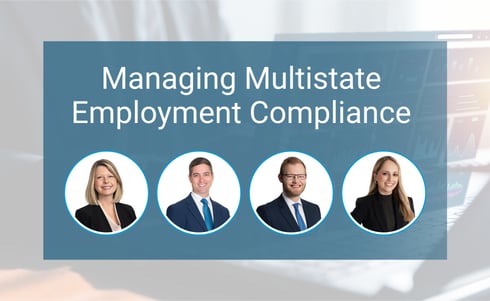
For employers with employees across multiple states, a single workplace policy can quickly become a multistate compliance issue. Federal law often provides the baseline, while states and local jurisdictions may impose additional or different requirements. The first question for employers is often a simple one: where are your employees working? During Dorsey’s 2026 Labor & Employment Symposium, Dorsey attorneys Ryan Gehbauer, Josh Hughes, Susan Lorenc and Zoe Spector joined Katie Ervin Carlson, Chief Counsel-North America Employment Law at Howden US, to discuss practical strategies for managing these overlapping requirements. For employers with employees across multiple states, a single workplace policy can quickly become a multistate compliance issue. Federal law often provides the baseline, while states and local jurisdictions may impose additional or different requirements. The first question for employers is often a simple one: where are your employees working? During Dorsey’s 2026 Labor & Employment Symposium, Dorsey attorneys Ryan Gehbauer, Josh Hughes, Susan Lorenc and Zoe Spector joined Katie Ervin Carlson, Chief Counsel-North America Employment Law at Howden US, to discuss practical strategies for managing these overlapping requirements. Four steps for multistate employers to consider: Map your footprint. Know where your employees are physically working, including remote employees. Categorize the issue. Some areas of employment law vary much more significantly from state to state. Paid leave and sick time, wage payment rules, restrictive covenants, and pay transparency are among the areas the panel identified as having particularly high variance. Identify the applicable requirements. Federal law may provide the floor, but state or local law may impose additional requirements. Employers should understand how those layers interact before adopting a policy. Choose the right approach. Depending on the issue and the employer’s footprint, the best solution may be a national policy, state-specific addenda, or a hybrid approach. There is no single approach that works for every employment issue. For example, the panel discussed how a multistate employer might use different templates for restrictive covenant agreements based on the employee’s location and role. That approach still requires ongoing review because state requirements continue to change and some jurisdictions require individualized analysis. Paid leave presents a different challenge. Requirements can vary significantly among jurisdictions, and a policy that is more generous to employees does not necessarily satisfy every state’s specific compliance requirements. The panel’s takeaway for multistate employers: know your footprint, consider where laws vary most before drafting policies, and build a process for reviewing policies as employees enter new states or laws change. National policies can create consistency, but employers should consider whether state-specific requirements could create unintended consequences. This post highlights key takeaways from “One Company, Fifty Rulebooks: Practical Strategies for Multistate Employment Compliance,” a panel presented at Dorsey’s 2026 Labor & Employment Symposium.
September 21, 2026
Employee Handbook / Policies
An Employment Lawyer’s Guide to Surviving the AI Workplace
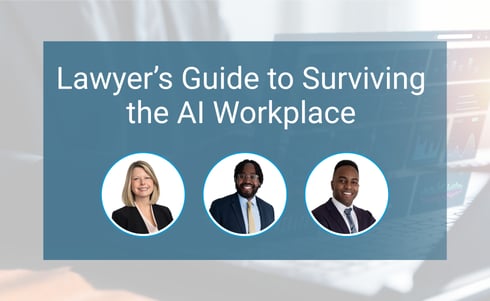
AI is becoming part of nearly every stage of the employment relationship, from recruiting and hiring to performance management, workplace investigations and litigation. While these tools can save time and make certain tasks easier, they can also create new legal and practical risks for employers. At Dorsey’s 2026 Labor & Employment Symposium, Dorsey attorneys Susan Lorenc, Henry Adebisi, and Julian Nunally joined Valeria R. Cometto, Assistant General Counsel at Delta Air Lines, to discuss how AI is changing the workplace and what employers can do to manage those risks. One area employers should be watching closely is recruiting and hiring. AI is increasingly being used for recruiting, resume screening, candidate ranking and interview-related tasks. But using a third-party tool does not shift responsibility for the resulting employment decisions. Employers still need to ensure those decisions comply with federal, state and local anti-discrimination laws. AI use can create challenges after an employee is hired as well. Managers and HR professionals may use AI to draft performance reviews, disciplinary notices, coaching documentation and performance improvement plans. Because AI can generate inaccurate information and cannot independently assess credibility or context, human review remains important before employers rely on those outputs. Employers should also consider what information employees are putting into AI tools. Personnel records, customer information, trade secrets and privileged communications can create confidentiality, privacy and privilege concerns when entered into public AI systems. Existing confidentiality policies may need to be updated to specifically address what employees can and cannot share with AI tools. AI is also changing employee complaints and the early stages of employment disputes. The panel discussed how AI can help employees create longer and more sophisticated complaints and demand letters containing legal terminology, statutory references and detailed allegations. As Julian explained during the discussion, employers should look beyond how polished a complaint appears and focus closely on the facts actually being alleged. Managing these risks starts with understanding how AI is actually being used within the organization. The panel discussed developing clear acceptable-use policies, establishing approval procedures for AI tools, updating confidentiality policies, training employees and managers, and regularly auditing AI use. Ultimately, AI should assist employment decision-making rather than replace human judgment. Employers remain responsible for their employment decisions, making human oversight and review an important part of using AI in the workplace. This post highlights key takeaways from “AI Is Ruining Your Life: An Employment Lawyer’s Guide to Surviving the AI Workplace,” a panel presented at Dorsey’s 2026 Labor & Employment Symposium.
September 16, 2026
Discipline and Discharge
Illinois Employment Law Updates for 2026: What Employers Need to Know
Illinois lawmakers were busy in 2025, passing laws and amendments to existing laws that impact Illinois employers as of January 1, 2026. First, Illinois amended the Illinois Human Rights Act (“IHRA”), which prohibits discrimination, harassment, sexual harassment, and retaliation against individuals in connection with employment. The Illinois Department of Human Rights (“IDHR”) administers the IHRA and is the agency to which employees submit complaints when they believe an employer has engaged in conduct that violates the IHRA. Effective January 1, 2026, it is now discretionary, rather than mandatory, for the IDHR to bring employee complaints to a fact-finding conference. This means the IDHR now has discretion to investigate employee complaints based on written submissions by the parties alone. Further, a previously passed IHRA amendment making it a civil rights violation for an employer to use AI in a manner that subjects employees to discrimination went into effect on January 1, 2026. Illinois employers must now ensure that AI used or relied upon to make employment decisions does not have a discriminatory effect on employees based on a protected class. Failure to notify employees of the employer’s use of AI is also now a civil rights violation. Third, Illinois’ VESSA law was amended and expanded as of January 1 to prohibit employers from firing, refusing to hire, discriminating against, or otherwise retaliating against an empl oyee who uses employer-issued devices to record a crime of violence, including domestic violence or sexual violence, committed against the employee or their family or household member. Next, the legislature amended the Illinois Workplace Transparency Act (“IWTA”). First enacted in 2019 in the midst of the #MeToo era, the IWTA restricted nondisclosure and nondisparagement language in employment, separation, and settlement agreements unless the clauses were mutual; limited the use of mandatory arbitration for sexual harassment or other discrimination claims; required annual sexual harassment training for all employees; and mandated that employers report settlements and adverse judgments to the Illinois Department of Human Rights. As of January 1, 2026, the IWTA has been amended to expand its scope and impact on employment, separation, and settlement agreements. For example, the definition of “unlawful employment practice” has been expanded to include most employment claims, including wage and occupational safety claims. The law also now includes a definition of “concerted activity” and provides that agreements may not prohibit, prevent, or restrict an employee from reporting allegations of unlawful conduct to government officials or engaging in concerted activity to address work-related issues. Perhaps most consequentially, the amendments address several technical provisions. The IWTA now provides that employers may not condition employment or continued employment on an agreement to shorten the applicable statute of limitations, apply non-Illinois law to an Illinois employee’s claim, state that confidentiality is the employee’s preference, or require a venue outside of Illinois to adjudicate an Illinois employee’s claim. Finally, confidentiality provisions related to alleged unlawful employment practices must be supported by distinct, bargained-for consideration separate from the consideration provided in exchange for a general release of claims. This may be accomplished by explicitly allocating a portion of the consideration payment to the confidentiality provision within the agreement. Other Illinois employment laws that went into effect on January 1, 2026, include: • Employee Blood and Organ Donation Leave Act: amended to apply to part-time employees • Nursing Mothers in the Workplace Act: requires employers to provide nursing mothers with reasonable paid break time to express milk • Family Neonatal Intensive Care Leave Act: requires employers to provide unpaid leave if an employee’s child is in the NICU In light of these changes to Illinois employment laws, now is a good time to review employment policies and agreements to ensure compliance with these acts and amendments.
April 6, 2026

Susan Lorenc Joined Dorsey & Whitney in Chicago as Partner in Labor & Employment Group
Susan Lorenc joined Dorsey as a Partner in the Labor & Employment group in Chicago. Susan brings extensive experience to her nationwide employment law practice, advising organizations on a wide range of workforce and compliance matters. She represents employers across industries, with a particular focus on the technology sector and numerous Chicago-area tech companies. Read more >
March 2, 2026



