
.

Blog Post

First Circuit: Lizzie Borden Themed Coffee Shop Serves Different Goods to Different Consumers from Guests at Lizzie Borden Bed and Breakfast

January 7, 2025 – The TMCA

by Ben Kappelman

Download as a PDF
Share this page

How many years must pass before a grisly murder can support a marketing effort? Apparently, something less than the 132 years since Lizzie Borden’s father and stepmother were axe murdered in Fall River, Massachusetts. (Yes, the passive voice is intentional—a jury acquitted prime suspect Lizzie, and the murders remain unsolved.)

Fall River is city of about 100,000 people that abuts the Rhode Island state line. It was once home to numerous textile mills and now hosts a collection of World War II-era naval vessels at Battleship Cove. Portions of the music video for Aerosmith’s 1993 hit Cryin’ (perhaps NSFW, if your boss won’t appreciate 90s-era rock’s visual themes) were filmed in Fall River. The city’s top attraction, however, is the 1800s-era house that was the scene of the double murder.
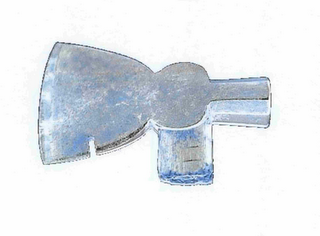
Today, US Ghost Adventures, LLC owns the Lizzie Borden House and offers ghost tours; overnight stays; and a collection of tasteful merchandise, like the “Bloody Axe in Head Play Headband.” Ghost Adventures owns several federal trademark registrations, including U.S. Trademark Reg. Nos. 2,070,882, for the word mark LIZZIE BORDEN and 4,397,555, for a hatchet logo, both for restaurant and hotel services. The hatchet logo features a notch along the bottom edge and, unlike the “bloody axe” merch, is not bloody. The Lizzie Borden House has operated as a tourist attraction since the 1990s, and Ghost Adventures’ federal registrations are incontestable.

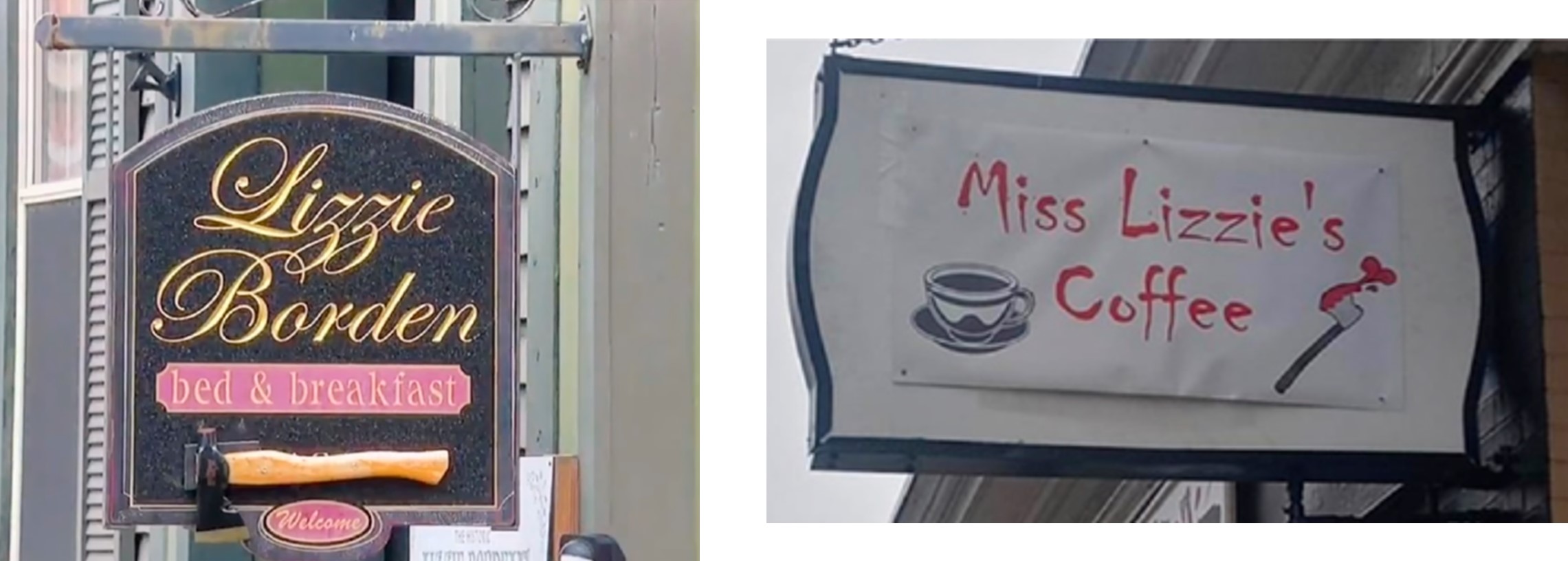
In 2023, Miss Lizzie’s Coffee LLC opened a coffee shop in the building adjacent to the Lizzie Borden House. A small grass strip and driveway separate the two buildings, which face a courthouse across the street (although not the courthouse where the jury weighed Lizzie’s fate). Miss Lizzie’s Coffee calls itself “The Most Haunted Coffee Shop in the World!” The original sign for Miss Lizzie’s Coffee featured letters made to look written with blood, and a stylized hatchet spewing blood. (Miss Lizzie’s Coffee’s website now reflects a sign with a coffee cup set against an appetizing blood splatter background.)

Ghost Adventures was not thrilled with its new neighbor and sued the coffee shop shortly after it opened. Ghost Adventures alleged that several visitors, and at least one city official, incorrectly assumed that the coffee shop was related to Ghost Adventures’ business. Ghost Adventures asserted, among other things, trademark infringement under the U.S. Lanham Act and sought an injunction against Miss Lizzie’s Coffee. The U.S. District Court for the District of Massachusetts denied the injunction request, and Ghost Adventures appealed to the U.S. Court of Appeals for the First Circuit.

The First Circuit affirmed the district court’s decision, agreeing that Ghost Adventures had not shown a sufficient likelihood of confusion to support its claim. Similar to courts around the country, the First Circuit applies an eight-factor likelihood-of-confusion test, which requires courts to weigh: “(1) the similarity of the marks; (2) the similarity of the goods; (3) the relationship between the parties’ channels of trade; (4) the relationship between the parties’ advertising; (5) the classes of prospective purchasers; (6) evidence of actual confusion; (7) the defendant’s intent in adopting its mark; and (8) the strength of the plaintiff’s mark.” Here, the court concluded that the marks were not similar, given that the trademarked hatchet has a “spotless,” notched blade, while Miss Lizzie’s hatchet is not notched, spews blood, and has a handle. The court observed that “Miss Lizzie’s” is incidentally similar to LIZZIE BORDEN, but noted that Ghost Adventures had not shown that its mark had displaced the story of Lizzie Borden in the minds of consumers—that is, there was no evidence that a consumer who hears of LIZZIE BORDEN thinks of the business instead of the murder.

The court then weighed the market similarity factors, that is “the similarity of the parties’ goods, the relationship between their channels of trade, the relationship between their advertising, and the classes of prospective purchasers.” Ghost Adventures sought to portray both businesses as sharing the category of “hospitality services,” but the court rejected this characterization as merely a “broad economic sector,” insufficient to support likely confusion. The court found the businesses were better characterized as serving different groups—Ghost Adventures targets “sophisticated tourists who purchase tickets in advance and travel to Fall River to visit the historical site of the Lizzie Borden House, whereas Miss Lizzie’s attracts passersby hoping for a caffeine kick or a bite to eat.”

Although both businesses rely on the Lizzie Borden story, confusion due to proximity or common reference to historical lore was not the type of confusion that Ghost Adventures was entitled to prevent. As the district court explained, “Ghost Adventures has not demonstrated that its mark bears the strength which might give it the ‘secondary meaning’ reach that, for example, ‘Sam Adams Beer’ might claim regarding the historical figure Sam Adams.” As such, Ghost Adventures could not use its LIZZIE BORDEN mark to prevent other hospitality businesses from opening in the vicinity of the crime and marketing themselves by using the Lizzie Borden story.

The court also rejected Ghost Adventures’ reliance on consumer confusion evidence. The court decided there was insufficient evidence that any confusion was caused by an infringing mark, as opposed to confusion due to nontrademarked similarities between businesses or products. As the court explained, “if two outdoor Saturday farmers’ markets opened on the same block, causing wandering shoppers to think that they were affiliated, their proximity and similar business models, without more, would not be suggestive of trademark infringement.”

This tussle over the use of the Lizzie Borden legacy shows the limits businesses face when they seek to market off historical sites and events. Had Lizzie Borden been the product of Ghost Adventures’ imagination and the Lizzie Borden House devoid of historical significance, there would be little doubt that Miss Lizzie’s Coffee would be deemed an infringer. But someone did “whack” Borden’s father and stepmother, although perhaps not 40-41 times, and her story became infamous. Given that historical reality, a business seeking to build its brand would need that brand to eclipse the story itself to demonstrate the strength needed for trademark enforcement.

Until then, Ghost Adventures’ tours, hospitality, and merchandise may have to coexist with Miss Lizzie’s food and beverage, each invoking Fall River’s most notorious resident. For their part, the two businesses don’t quite seem ready to bury the hatchet—they filed papers in the district court on December 20, 2024, stating their intent to proceed with discovery in the litigation. Should they continue, Massachusetts may end up the scene of the most famous trial involving Lizzie Borden since 1892.


Firm Highlights

Insights

Ninth Circuit Splits California’s Climate Disclosure Laws: Scope 1 and 2 Reporting Proceeds; Scope 3 and SB 261 Likely Unconstitutional

Key Takeaways On November 9, 2026, the Ninth Circuit in Chamber of Commerce v. Sanchez allowed Scope 1 and Scope 2 greenhouse gas (GHG) emissions reporting under SB 253 to proceed but held that SB 253’s Scope 3 requirement, and SB 261 in its entirety, likely violate the First Amendment.1 U.S.-formed entities with total annual revenues above $1 billion that do business in California remain subject to Scope 1 and 2 reporting. First reports (or, for eligible entities, statements of non-reporting) were due November 10, 2026.2 Scope 3 reporting (scheduled to begin in 2027) and SB 261 climate-risk reporting are effectively on hold. Entities with revenues between $500 million and $1 billion, which were covered only by SB 261, currently have no reporting obligation under either law.3 The ruling addresses only preliminary injunctive relief; it is not a final judgment on the merits. If the district court finds the Scope 3 requirement non-severable, it could also enjoin Scope 1 and 2 reporting.4 Background SB 253 (the Climate Corporate Data Accountability Act) requires U.S.-formed entities with total annual revenues above $1 billion that do business in California to report Scope 1 and 2 emissions starting in 2026 and Scope 3 emissions starting in 2027, with penalties of up to $500,000 per reporting year.5 SB 261 (the Climate-Related Financial Risk Act) requires U.S.-formed entities with total annual revenues above $500 million that do business in California to publish biennial climate-related financial risk reports consistent with the Task Force on Climate-related Financial Disclosures (TCFD) framework, with penalties of up to $50,000 per reporting year.6 Business groups led by the U.S. Chamber of Commerce challenged both laws as compelled speech that violates the First Amendment. In August 2025, the district court denied their motions for preliminary injunctions. On November 18, 2025, the Ninth Circuit enjoined SB 261 pending appeal but declined to enjoin SB 253.7 The implementing regulation adopted by the California Air Resources Board (CARB) took effect on October 12, 2026, and set November 10, 2026, as the first Scope 1 and 2 reporting deadline.8 The Court’s Decision Scope 1 and Scope 2: Upheld for Now The panel held that Scope 1 and 2 disclosures are commercial speech because they compel disclosure of factual information about emissions from a company’s own operations and purchased energy—information that bears on capital transactions. Applying intermediate scrutiny, the court concluded that the requirements advance California’s substantial interests in reducing information asymmetries for investors and in reducing emissions and are no more extensive than necessary.9 The panel split 2–1 on this issue.10 Scope 3: Likely Unconstitutional The court held that Scope 3 disclosures concern diffuse third-party conduct across the value chain and are “insufficiently tethered” to the reporting entity’s own operations to qualify as commercial speech. Applying strict scrutiny, the court concluded that the requirement likely fails because (1) SB 253 does not require primary data, (2) the record did not show that companies’ proxy-based estimates would be more reliable than estimates the State could generate itself, and (3) the link to investor-relevant risk was too remote.11 SB 261: Likely Unconstitutional in Its Entirety The court held that SB 261 compels noncommercial speech because it requires “predictive and normative judgments” about a “politically fraught subject.” Even assuming California’s interests are compelling, the court reasoned that the law is likely not narrowly tailored because California could use less restrictive alternatives, such as incentives for voluntary disclosure.12 The panel was unanimous on Scope 3 and SB 261.13 Remand and Severability The Ninth Circuit did not enter injunctions itself. It reversed the denials of preliminary injunctive relief and remanded with instructions for the district court to enter relief consistent with the opinion and, for Scope 3, to decide severability first.14 SB 253 contains an express severability clause. If the district court nevertheless finds the Scope 3 requirement non-severable, it could also enjoin Scope 1 and 2 reporting.15 Current Status at a Glance Requirement Status after the Ruling Practical Effect SB 253 – Scope 1 and 2 emissions (entities with revenues above $1 billion) In effect; denial of preliminary injunction affirmed First reports were due November 10, 2026; CARB fee notices expected by December 10, 202616 SB 253 – Scope 3 emissions (scheduled to begin in 2027) Likely unconstitutional; remanded for severability ruling and entry of injunctive relief Not required while remand is pending; scope of CARB’s 2027 rulemaking uncertain17 SB 261 – climate-related financial risk reports (entities with revenues above $500 million) Likely unconstitutional in its entirety; enjoined pending appeal since November 18, 2025 No current reporting obligation; voluntary reports permitted18 What to Watch Any petition for panel rehearing or rehearing en banc (due 14 days after entry of judgment) and any petition for a writ of certiorari to the U.S. Supreme Court.19 The district court’s severability ruling and the scope of any preliminary injunctions it enters as to Scope 3 and SB 261.20 CARB’s response. As of the date of this alert, CARB has not issued a formal statement on the opinion.21 CARB had been developing a second rulemaking for reporting years 2027 and later, addressing Scope 3, assurance, deadlines, and reporting templates, and had proposed retaining November 10 as the annual deadline.​​​​​​​22 Recommended Actions Confirm coverage entity by entity. Revenue (gross receipts, based on the lesser of the two prior fiscal years) and “doing business in California” are determined separately for each entity; affiliates are not aggregated. Retain supporting California tax records for five years.23 If a covered entity has not filed, file promptly. Submit the Scope 1 and 2 report (or, if eligible, a statement of non-reporting) and document good-faith compliance efforts, which CARB must consider in assessing penalties.24 Calendar the fee cycle. CARB expects to issue fee notices by December 10, 2026, with payment due within 60 days after the notice; each day of nonpayment is a separate violation.​​​​​​​25 CARB’s August 2025 proposal set flat fees at $3,106 per SB 253 entity and $1,403 per SB 261 entity.26 Confirm the final amount when the CARB notice arrives. Prepare for 2027 Scope 1 and 2 reporting. Third-party assurance was not required for 2026, but CARB has signaled that it will require limited assurance of Scope 1 and 2 data for 2027 and later years.27 Engage assurance providers and strengthen internal data controls now. Pause, but preserve, Scope 3 and SB 261 workstreams. Maintain existing data and processes: the ruling is preliminary, and many multinational companies will still need Scope 3 and product-level emissions data under the EU’s Corporate Sustainability Reporting Directive (CSRD) and Carbon Border Adjustment Mechanism (CBAM).28 Companies may still publish SB 261 reports voluntarily.29 Review public statements. Continue to review voluntary climate disclosures for consistency with CARB filings and other regulatory reports. Considerations for Real Estate and Infrastructure Clients The following are practice recommendations, not statutory requirements: Control boundaries. Whether emissions from a building or data center fall within a landlord’s or a tenant’s Scope 1 or 2 inventory depends on the control approach applied under the GHG Protocol. Leases, colocation agreements, and powered-shell arrangements should specify which party has operational control for GHG reporting purposes. Data cooperation. Include obligations to deliver utility and energy data (with specified timing and format) and to cooperate with assurance providers, particularly where the landlord or operator holds the utility accounts. Transactions. In acquisitions and financings, diligence the target’s or borrower’s SB 253 compliance and fee payments, and consider representations and covenants on the accuracy of emissions data. Value-chain requests. Counterparty requests for Scope 3 data may slow, but those subject to CSRD will likely continue to make them. This alert is for general information only and is not legal advice. The law in this area is changing rapidly, and developments after November 18, 2026, may affect this analysis.  1 Chamber of Commerce v. Sanchez, No. 25-5327 (9th Cir. Nov. 9, 2026) 2 White & Case, California Climate Disclosure Laws: Ninth Circuit Finds SB 253 Scope 3 Requirements and SB 261 Likely Unconstitutional (Nov. 2026) 3 Legal 500, Ninth Circuit Approves California’s Core Carbon Emissions Reporting Rules (Nov. 2026) 4 White & Case, supra note 2. 5 Kirkland & Ellis, Ninth Circuit Rules on California’s Climate Disclosure Laws (Nov. 2026) 6 Simpson Thacher, California Climate Reporting Laws: Ninth Circuit Issues Partial Injunction (Nov. 2025) 7 White & Case, supra note 2. 8 Vinson & Elkins, OAL Approves CARB’s Initial Regulation (Oct. 2026) 9 White & Case, supra note 2. 10 Foley & Lardner, California Climate Disclosure Laws (Nov. 2026) 11 White & Case, supra note 2. 12 Chamber of Commerce, No. 25-5327. 13 Kirkland & Ellis, supra note 5. 14 Troutman Pepper Locke, Ninth Circuit Rules on Challenge to California’s Climate Disclosure Laws (Nov. 2026) 15 White & Case, supra note 2. 16 Davis Polk, Getting Ready for California SB 253’s November 10 Reporting Deadline (Oct. 2026) 17 Troutman Pepper Locke, supra note 14. 18 White & Case, supra note 2. 19 Id. 20 Troutman Pepper Locke, supra note 14. 21 Morgan Lewis, Ninth Circuit Reverses Lower Court (Nov. 2026) 22 Simpson Thacher, CARB Provides New Guidance on SB 253 Reporting (July 2026) 23 Davis Polk, supra note 16. 24 Id. 25 Id. 26 CARB, SB 253/261 Public Workshop Slides (Aug. 2025) 27 Vinson & Elkins, supra note 8. 28 O’Melveny, Is Your Company Still Required to Report Under California’s Climate Laws? (Nov. 2026) 29 White & Case, supra note 2.




