Client Alert
SEC Proposes Comprehensive Reform to Executive and Director Compensation Disclosure
November 23, 2026
by Josh Erekson, Cam C. Hoang, and David Goodwin
Download as a PDF
On November 13, 2026, the SEC issued a proposed rule providing for significant amendments to the executive and director compensation disclosure requirements of Item 402 of Regulation S-K, the most comprehensive updates to these requirements since the SEC introduced the CD&A in 2006. The proposed amendments seek to scale back the existing disclosure requirements by, among other things, limiting the number of named executive officers, simplifying the tabular disclosure rules, raising the reporting threshold for perquisites, and lowering the compliance burdens associated with the Dodd-Frank Act. The SEC’s focus on principles-based and materiality-focused disclosure is a significant shift from the decades-old compensation disclosure rules and would provide companies with greater flexibility in presenting compensation information consistent with the design of their compensation programs.
When would companies be permitted, or required, to comply with the final rule?
Under the current proposal, the effective date would be January 1st after the year in which final rules are adopted and published in the Federal Register. With a 60-day comment period that starts at Federal Register publication, 2027 is the soonest that the final rules could be adopted. Voluntary compliance could begin any time after the effective date, so 2028 proxy statements would be the first that might follow the new rules, provided that voluntary adopters must comply in full with amended Item 402. Mandatory compliance would begin with 2029 proxy statements.
Named Executive Officers
The proposal would provide that a company’s named executive officers (NEOs) consist only of each person who served as the company’s principal executive officer (PEO) or principal financial officer (PFO) during the last completed fiscal year (including individuals who served in these capacities for any part of the year). In most circumstances, a company therefore would report compensation for two officers rather than the five principal officers generally covered by the current rules. Smaller reporting companies (SRCs) and emerging growth companies (EGCs) currently benefit from scaled requirements that generally cover the PEO and two other executive officers and would also be limited to two NEOs under the proposed rules.
The proposal would eliminate from the mandatory NEO group the company’s three other most highly compensated executive officers and up to two additional former executive officers who would have been included but for their departure during the year. A company could voluntarily include additional executives in the new compensation tables, but an additional executive would need to appear consistently in all three tables. Voluntary inclusion would not make that executive an NEO for other provisions tied to the Item 402 definition.
The narrower definition would have effects beyond the annual proxy statement because other disclosure provisions use the NEO concept. For example, the proposal could narrow certain reporting obligations under Item 5.02 of Form 8-K, individual beneficial ownership disclosure under Item 403(b), and the treatment of compensatory arrangements as deemed material exhibits under Item 601. The change would not, however, reduce the separate group of “covered employees” subject to Section 162(m) of the Internal Revenue Code; companies would still need to identify and calculate compensation for that tax-law population.
Primary Tabular Disclosure Requirements
The proposal would replace the Summary Compensation Table, Grants of Plan-Based Awards Table, Outstanding Equity Awards at Fiscal Year-End Table, and Option Exercises and Stock Vested Table with three new tables intended to show (1) compensation granted, (2) compensation earned, and (3) the status of equity awards between grant and realization. It also would eliminate the separate Pension Benefits and Nonqualified Deferred Compensation tables.
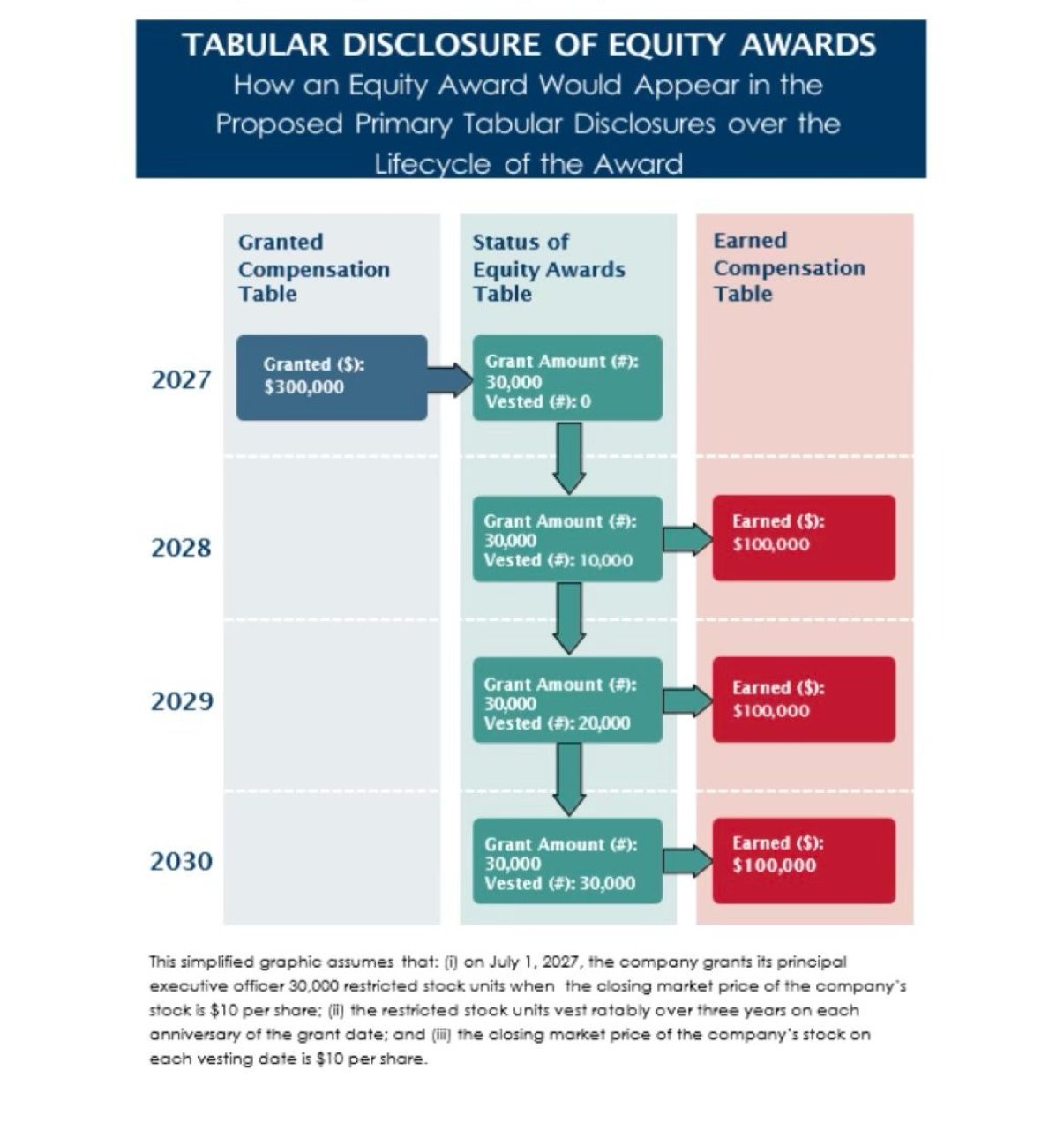
Granted Compensation Table. This table would present the principal elements of compensation granted for each covered fiscal year, generally at target value. It would include annualized salary as of the last day of the fiscal year, non-equity awards granted (including cash bonuses and non-equity incentive awards), equity awards valued at grant-date fair value under FASB ASC Topic 718 assuming target performance, and total compensation granted. To better align disclosure with the performance period, a company could elect to report an equity award granted during the first quarter after fiscal year-end as compensation for the preceding year if the company considers the award to relate to performance in that year. The company would need to apply that election consistently over time and disclose it.
Earned Compensation Table. This table would report compensation earned during each covered fiscal year, including salary earned; non-equity awards earned; stock awards that vested; option awards that were exercised; retirement plan contributions, perquisites, tax gross-ups, and other miscellaneous compensation received; and total compensation earned. For equity awards, the table would focus on the value realized—stock awards when vested and option awards when exercised—rather than the grant-date value currently shown in the Summary Compensation Table. The SEC describes this table as a comprehensive picture of compensation outcomes, including value ultimately earned from awards granted in prior years.
Status of Equity Awards Table. This award-by-award table would connect the Granted Compensation Table and the Earned Compensation Table. It would track each equity award from the year in which it is first reported as granted until the award is fully vested or exercised, forfeited, or expired. The table would disclose material award terms and annual status information in one location, allowing investors to follow an award through its lifecycle.
The Granted Compensation Table and Earned Compensation Table generally would cover the last three completed fiscal years, with two years for SRCs and EGCs. The new historical presentation may require companies to reconstruct prior-year information when the rules are first used. Large accelerated filers would be required to tag all three tables in Inline XBRL.
The proposal also would give companies flexibility to add or split columns, supplemental tables, footnotes, or narrative disclosure if necessary to explain the required information. Although the prescribed tables would be streamlined, companies would remain responsible for providing any material information needed to understand the amounts presented. The proposed amendments remove the example list of topics for narrative disclosure, requiring a company to consider the context around the quantitative disclosure in the tables to determine what supplemental information is necessary to an understanding of their tabular disclosures.
Perquisites and Other Personal Benefits
The proposal would raise the minimum aggregate threshold for reporting perquisites and other personal benefits from $10,000 to $150,000 for each NEO. It also would create a de minimis tracking exclusion for an individual perquisite that qualifies as a de minimis fringe benefit under Section 132(a)(4) of the Internal Revenue Code—generally, property or services whose value and frequency make accounting unreasonable or administratively impracticable. A qualifying item would not need to be tracked when determining whether the $150,000 aggregate threshold has been reached.
The SEC also proposes to withdraw portions of its 2006 interpretive guidance that have constrained company judgment. The existing two-step framework would remain: an item is not a perquisite if it is integrally and directly related to the performance of the executive’s duties; otherwise, an item conferring a direct or indirect benefit that has a personal aspect generally is a perquisite unless it is broadly available on a nondiscriminatory basis to all employees. Under the proposal, however, a company could determine whether a benefit is integrally and directly related to an executive’s duties based on the facts and circumstances, so long as its determination is reasonable and made in good faith.
The SEC would remove examples in the current guidance that characterize particular items as perquisites, including security provided at an executive’s residence or during personal travel. The proposing release explains, for example, that if a company reasonably and in good faith determines that requiring an executive to use company aircraft for personal travel because of security concerns is integrally and directly related to the executive’s duties, the travel would not be a perquisite. The proposal also would eliminate the requirement to value perquisites exclusively at the company’s aggregate incremental cost. Companies could continue using that measure, but could use another valuation method, including the amount determined for federal income tax purposes.
Dodd-Frank-Related Disclosure
The proposal would simplify three disclosure regimes adopted pursuant to Dodd-Frank—pay-versus-performance, clawbacks, and CEO pay ratio—while leaving the statutory mandates and, in the case of clawbacks, the underlying recovery process intact.
Pay-versus-performance. The specialized “compensation actually paid” calculation would be replaced by total compensation earned from the proposed Earned Compensation Table. The required performance measure would be limited to the company’s cumulative total shareholder return, peer-group total shareholder return, net income, and the company-selected measure. The separate list of financial performance measures would no longer be required. The covered period would be reduced from five fiscal years to three, and the covered executives would be limited to the PEO and PFO. A company could voluntarily provide additional performance measures.
Clawbacks. The proposal would remove the two check boxes on the cover pages of Forms 10-K, 20-F, and 40-F concerning corrections of errors in previously issued financial statements and related recovery analyses. It also would eliminate the requirement to explain why recovery was not required when a company prepared an accounting restatement but concluded that no recovery was due under its listing-standard-compliant clawback policy. The mechanics of the required clawback policy and recovery analysis would not change.
CEO pay ratio. For purposes of identifying the median employee, a company could limit the relevant population to full-time U.S. employees, excluding part-time, seasonal, temporary, and non-U.S. employees. The company would need to identify a new median employee at least once every five years instead of once every three years, subject to the rule’s reassessment requirements. Annual total compensation for the CEO and median employee would be determined using the information reported in, or the methodology applicable to, the proposed Granted Compensation Table.
Director Compensation Disclosure
The proposal would retain qualitative and quantitative disclosure of the material aspects of a company’s director compensation program and the compensation earned by each person who served as a director during the last completed fiscal year. It would, however, eliminate the prescribed Director Compensation Table. A company could use narrative, tabular, or combined disclosure, depending on how its director compensation program is structured and what presentation would be clearest.
At a minimum, a company would quantify the cash earned by each director during the year and the aggregate dollar value realized on the vesting of stock awards or exercise of option awards during the year, and disclose any other material compensation earned. For outstanding director equity awards, the company would disclose the number of awards outstanding at fiscal year-end and, for each award, the grant date, vesting schedule, and other material performance, market, or service conditions. The proposal would remove specific line-item requirements for compensation elements that are not typical of most director programs, such as changes in pension value and above-market earnings on nonqualified deferred compensation, but those amounts would still need to be considered under the broader requirement to disclose other material compensation.
Other Notable Changes
Scaled disclosures. The proposed amendments would preserve scaled executive compensation disclosure for SRCs and EGCs, while simplifying the current framework by consolidating the applicable accommodations into proposed Item 402(a)(6). SRCs and EGCs would continue to benefit from reduced disclosure requirements and exemptions from certain Dodd-Frank Act provisions, rather than becoming subject to the full Item 402 regime. The SEC also noted that, if its separate May 2026 filer-status proposal is adopted as proposed, the Item 402 accommodations for SRCs and EGCs would instead be extended to all non-accelerated filers, consistent with that proposal’s contemplated elimination of SRC status. The SEC has estimated that over 80% of public companies would qualify for scaled disclosures under the proposed amendments.
Compensation Discussion and Analysis (CD&A). The proposal would replace the current prescriptive framework and list of 15 illustrative topics with three required subjects: (1) the objectives of the compensation program in relation to corporate strategy; (2) the material elements of compensation and how the amounts are determined; and (3) if applicable, whether and how the company considered the results of its most recent say-on-pay vote in making compensation policies and decisions. SRCs and EGCs would remain exempt from providing the CD&A.
Termination and change-in-control arrangements. Companies would no longer be required to quantify payments under hypothetical year-end termination and change-in-control scenarios. Instead, they would provide qualitative disclosure of the material terms of plans and agreements that provide payments in connection with a termination or change in control, excluding broad-based arrangements that do not discriminate in favor of executive officers. Information previously disclosed under Item 5.02 of Form 8-K could be incorporated rather than repeated.
Golden parachute compensation. The proposal would retain, but streamline, the golden parachute table by consolidating compensation into cash, equity, and miscellaneous categories and replacing prescriptive footnotes with a requirement to disclose material information necessary to understand the quantified payments. Companies would have greater flexibility to supplement the table with narrative disclosure.
Registration statement timing. Long-form registration statements—including Forms S-1, S-4, and S-11, Form 10, and Form N-2 filed by a business development company—generally would not need Item 402 disclosure for the most recently completed fiscal year until the earlier of the filing of the company’s Exchange Act annual report containing that disclosure or 120 days after fiscal year-end.
Eliminated disclosures. The proposal would eliminate the requirement to discuss compensation policies and practices that create reasonably likely material adverse risks under Item 402(s). It also would eliminate the recently adopted Item 402(x) disclosure concerning option-award timing in relation to the release of material nonpublic information.
Effective Date and Practical Considerations for Implementation
While the proposal would substantially revise Item 402, several existing provisions would remain largely unchanged. In particular, the proposed rules would retain, with limited streamlining, the existing requirements regarding foreign private issuers, disclosure for a full fiscal year, and the definitions used in Item 402. The proposed amendments remain subject to public comment with the public comment period remaining open for 60 days after publication, and these amendments may change before any final rules are adopted. Accordingly, companies should continue to comply with the existing executive and director compensation disclosure requirements. If adopted as proposed, however, companies would be permitted, after the effective date but before their mandatory compliance date, to elect to comply early with the amended requirements, provided that they comply with amended Item 402 in its entirety.
Companies and their compensation committees should familiarize themselves with the proposed framework and consider how the changes, if adopted, could affect their existing compensation disclosure processes, including the identification of NEOs, preparation of the CD&A and compensation tables, collection and valuation of perquisite information, and Dodd-Frank Act disclosures. The proposed amendments would become effective as of January 1 of the year after publication, so if adopted in 2027, disclosure would be for the year beginning January 1, 2028, for fiscal year-end filers, with disclosure beginning in the 2029 proxy statement. Companies should also consider whether early compliance may be appropriate based on their particular compensation programs and disclosure practices once the final rules and applicable effective date are known. Companies may also wish to consider submitting comments to the SEC regarding aspects of the proposal that could materially affect their compensation programs or disclosure practices.
Disclosure rules are complex and Dorsey’s capital markets attorneys are available if you would like to make any comments to the proposed rules or have questions regarding the revised disclosures.