.

Elena’s people-focused approach to the law lends itself well to everyday challenges faced by employers of all sizes.

Elena represents employers before federal and state agencies and jurisdictions, handling claims arising under Title VII, the Americans with Disabilities Act (“ADA”), and other statutory frameworks. Beyond litigation, Elena advises clients navigating the complexities of employment law, including handbook and policy creation, workforce restructuring, and employee discipline and discharge.

Elena is a skilled internal investigator, successfully navigating large and small workplaces to investigate employee discrimination, harassment, and retaliation allegations and proactively advise clients on practices to mitigate future risk. Elena’s employment practice blends with her background in healthcare litigation, where she has secured favorable outcomes for provider employees in board investigations and medical malpractice actions.

Education

  • University of Minnesota Law School (J.D., 2022)
    • magna cum laude; Dean’s List; National Moot Court Competition Team; Public Service Recognition
  • University of Minnesota (B.A., Political Science, 2017)
    • Graduate with Distinction; President’s Student Leadership and Service Award

Bar Admissions

  • Minnesota

Court Admissions

  • U.S. District Court for the District of Minnesota
  • U.S. Court of Appeals for the Eighth Circuit

Accolades

  • Dorsey & Whitney – Scales of Justice Team Award (Afghan Asylee Team), 2024
  • Consistently providing pro bono legal assistance to those in need through Dorsey’s Pro Bono program
  • MSBA North Star Lawyer, 2022-2025

Insights

Blog Post

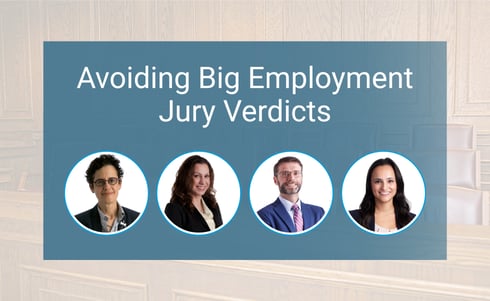
Avoiding Big Employment Jury Verdicts: What Employers Should Know

October 21, 2026

Blog Post

What impact has New York’s expanded employee whistleblower statute had on the scope of workers’ protected activities, and what steps can employers take to mitigate the risks of whistleblower claims?

August 11, 2024

When an employer disciplines its employees, let’s say for unsatisfactory performance or misconduct, employees sometimes respond with accusations that the discipline illegitimately occurred in retaliation for conduct protected by law.  For example, an employee may claim that the employer imposed discipline due to the employee’s previous expression of a concern relating to the employer’s compliance with law in conducting its business.  Although the laws do not prohibit the employer from imposing discipline based on the employee’s performance or misconduct, the laws often do protect the employee’s right to express concerns about compliance with law.  Managing such claims requires employers not only to untangle the conflicting factual assertions about the underlying reason for the discipline, but often requires the employer to sort out a complex web of statutes, each with different language and varying requirements for the assertion of a retaliation claim. As of 2022, New York became one of a number of states that have sought to strengthen the protection of employees’ rights to express concerns about their employers’ compliance with law.  Under an amended New York Labor Law § 740, New York workers may now assert causes of action for alleged retaliation occurring due to complaints about a violation of a “law, rule or regulation.”  Now, a violation of § 740 provides a right to a jury trial, the possibility of punitive damages for willful violations, civil penalties, a 2-year statute of limitations, and other relief not previously available as remedies for retaliation under myriad federal and state statutes. In this article we will analyze the broadened scope of § 740, as well as several recent court decisions that have addressed the expanded definition of the term “law, rule or regulation.” We will then propose several practices employers may consider when responding to employee concerns regarding their employers’ compliance with law. Labor Law § 740 Before amendment of New York Labor Law § 740 in 2021, the statute narrowly protected an employee who “discloses, or threatens to disclose to a supervisor or to a public body an activity, policy or practice of the employer that is in violation of law, rule or regulation which violation creates and presents a substantial and specific danger to the public health or safety, or which constitutes health care fraud.”  N.Y. Lab. Law § 740(a)(2) (2021). The law required the employee to show not only that the employee disclosed concerns related to public health, safety or healthcare fraud.  It also required that the employer had actually violated the law. The 2021 amendment relaxed this standard.  Now § 740 protects an employee who:  “discloses, or threatens to disclose to a supervisor or to a public body an activity, policy or practice of the employer that the employee reasonably believes is in violation of law, rule or regulation or that the employee reasonably believes poses a substantial and specific danger to the public health or safety.”  N.Y. Lab. Law § 740(a)(2) (2024) (emphasis added). Thus, the statute now prohibits retaliation against an employee if the employee “reasonably believes” an employer activity, policy, or practice violates a law, rule or regulation or poses a danger to public health and safety. Law, Rule or Regulation Section 740 now defines “law, rule or regulation” to include “(i) any duly enacted federal, state or local statute or ordinance or executive order; (ii) any rule or regulation promulgated pursuant to such statute or ordinance or executive order; or (iii) any judicial or administrative decision, ruling or order.” N.Y. Lab. Law § 740(1)(c). This updated definition now includes within “law, rule or regulation” executive orders, judicial or administrative decisions, rulings or orders, and rules promulgated pursuant to executive orders.  A number of courts have recently interpreted the term “law, rule or regulation” and have set some boundaries employers should consider as they evaluate their policies and practices. In Pierce v. Better Holdco, Inc., 2023 U.S. Dist. LEXIS 177137 (S.D.N.Y. Sep. 29, 2023), the U.S. District Court for the Southern District of New York held that the plaintiff sufficiently alleged protected activity by raising complaints related to violations of the California and federal WARN Acts, misrepresentations regarding website traffic in a SEC filing, and misrepresentations of profitability to investors. The plaintiff, the vice president of sales, operations, and customer service, was placed on administrative leave and terminated after raising these concerns. The Court emphasized that the plaintiff did not allege that the employer did or even intended to violate the WARN Act and that § 740 no longer requires such allegations. The Court stated that the plaintiff needed to demonstrate only a reasonable belief that the WARN Act had been violated. Additionally, although the plaintiff did not explain how the SEC filing misrepresentation violated the law, the Court held that the statute still protected the employee for disclosing “a reasonable belief of a violation of law” to her supervisors. The plaintiff attempted to allege two additional acts of protected conduct related to false statements made in an email and misrepresentations made regarding the company’s platform. However, the Court held the plaintiff did not plausibly allege she reasonably believed a violation of law had occurred for either act. Another case from the Southern District of New York held that the plaintiff stated a claim for retaliation after raising concerns regarding certain legal requirements relating to a sales and consumption tax. In Collison v. WANDRD, LLC, 2024 U.S. Dist. LEXIS 110062 (S.D.N.Y. June 20, 2024), the plaintiff, a customer service 1099 employee later promoted to a financial management W-2 position, alleged that he raised concerns that his employer violated requirements related to sales and consumption tax filings on multiple occasions. Following expression of these concerns, the plaintiff faced adverse employment actions, including eventual termination of employment. The Court denied the defendants’ motion to dismiss the retaliation claim. In contrast to the outcomes in Pierce and Collision, other cases have found that the concerns expressed by an employee fell outside of the definition of “law, rule or regulation.” In Zhang v. Centene Mgmt. Co., 2023 U.S. Dist. LEXIS 68718 (E.D.N.Y. Feb. 2, 2023), the Court considered whether certain policy statements issued by the New York Department of Health’s (“DOH”) Office of Insurance Programs constituted a “law, rule or regulation” for purposes of § 740. The plaintiff was a registered nurse care manager whose employer agreed to follow Managed Long Term Care (“MLTC”) Policy 16.06 promulgated by the DOH. The plaintiff reported her employer’s noncompliance with the Policy, resulting in a DOH investigation and restorative action. The plaintiff was terminated and brought an action for retaliation under § 740.The Court determined that MLTC Policy 16.06 provided guidance on regulations related to personal care services and was not a binding rule promulgated by statute or ordinance. The Court further evaluated the Policy under the amended definition of “law, rule or regulation,” including regulations promulgated by executive order or judicial or administrative decision, ruling, or order. In doing so, the Court cited to HC2, Inc. v. Delaney, 510 F. Supp. 3d 86, 100 (S.D.N.Y. 2020), a pre-amendment case holding that COVID-19 guidances issued by the Centers for Disease Control and Prevention and the New York City Department of Health were not “mandates or dictates” promulgated pursuant to the relevant administrative procedures governing federal and city regulations, and therefore lacked the force of law to predicate § 740 claims. Applying this logic, the Zhang Court held that the Policy was merely a notice provision or “directive” that did not give rise to a § 740 whistleblower retaliation claim. Retroactive Application Another issue with which courts are grappling under § 740 is whether the expanded definition of “law, rule or regulation” applies retroactively to conduct occurring before the amendment took effect on January 26, 2022.  Courts are currently divided as to the retroactive application of the amendment. See Callahan v. HSBC Sec., 2024 U.S. Dist. LEXIS 47106 (S.D.N.Y. Mar. 18, 2024) (collecting cases). Courts allowing retroactive application point to the “remedial” nature of the amendment, finding a legislative intent to correct the “restrictive nature of the prior statutory requirements.” Id. at *17-18. Other courts find that the amendment’s broadened protections provide a new basis upon which to find relief and therefore cannot be applied retroactively. See Pisano v. Reynolds, 2023 N.Y. Misc. LEXIS 2573, at *6 (N.Y. Sup. Ct. May 23, 2023). Practice Pointers Now that the New York Legislature has expanded § 740 to cover an employee’s assertion of concerns regarding laws in addition to those related to public health, safety, or healthcare fraud, employers should consider implementing several best practices including the following: Ensure that employment policies include clearly defined channels of communication which allow employees to raise concerns to supervisory and management staff, including concerns falling outside of the scope of their specific jobs; Such policies should include “bypass procedures” which allow the employee to escalate concerns to more senior levels of management, to human resources, internal audit or compliance staff. Such bypass procedures are particularly appropriate in the event that the employee concern involves the employee’s direct supervisor or to members of senior management who may be conflicted about considering the employee’s concerns; Where the company does not have sufficient resources to create an effective bypass procedure, the company should consider whether members of the board of directors should be appropriate avenues for particular concerns; Train those in management and supervisory roles on how to document and address employee concerns effectively, or to refer such concerns to the right persons who are best able to address them; Keep management up to date regarding changes in industry regulations and employee protections, including those established by federal, state and local law, executive orders and rules promulgated under such laws; Address concerns from former employees and independent contractors, inasmuch as such persons are now within the scope of persons protected by § 740; and Understand that a lack of an actual violation of law is no longer a viable defense to a claim under § 740, and that an employee engages in protected activity if the employee “reasonably” believes that a violation of a “law, rule, or regulation” has occurred. Reprinted with permission from the August 7, 2024 edition of the NEW YORK LAW JOURNAL © 2024 ALM Media Properties, LLC. All rights reserved. Further duplication without permission is prohibited. ALMReprints.com – 877-257-3382 – reprints@alm.com.

Firm Highlights

Insights

Ninth Circuit Splits California’s Climate Disclosure Laws: Scope 1 and 2 Reporting Proceeds; Scope 3 and SB 261 Likely Unconstitutional

Key Takeaways On November 9, 2026, the Ninth Circuit in Chamber of Commerce v. Sanchez allowed Scope 1 and Scope 2 greenhouse gas (GHG) emissions reporting under SB 253 to proceed but held that SB 253’s Scope 3 requirement, and SB 261 in its entirety, likely violate the First Amendment.1 U.S.-formed entities with total annual revenues above $1 billion that do business in California remain subject to Scope 1 and 2 reporting. First reports (or, for eligible entities, statements of non-reporting) were due November 10, 2026.2 Scope 3 reporting (scheduled to begin in 2027) and SB 261 climate-risk reporting are effectively on hold. Entities with revenues between $500 million and $1 billion, which were covered only by SB 261, currently have no reporting obligation under either law.3 The ruling addresses only preliminary injunctive relief; it is not a final judgment on the merits. If the district court finds the Scope 3 requirement non-severable, it could also enjoin Scope 1 and 2 reporting.4 Background SB 253 (the Climate Corporate Data Accountability Act) requires U.S.-formed entities with total annual revenues above $1 billion that do business in California to report Scope 1 and 2 emissions starting in 2026 and Scope 3 emissions starting in 2027, with penalties of up to $500,000 per reporting year.5 SB 261 (the Climate-Related Financial Risk Act) requires U.S.-formed entities with total annual revenues above $500 million that do business in California to publish biennial climate-related financial risk reports consistent with the Task Force on Climate-related Financial Disclosures (TCFD) framework, with penalties of up to $50,000 per reporting year.6 Business groups led by the U.S. Chamber of Commerce challenged both laws as compelled speech that violates the First Amendment. In August 2025, the district court denied their motions for preliminary injunctions. On November 18, 2025, the Ninth Circuit enjoined SB 261 pending appeal but declined to enjoin SB 253.7 The implementing regulation adopted by the California Air Resources Board (CARB) took effect on October 12, 2026, and set November 10, 2026, as the first Scope 1 and 2 reporting deadline.8 The Court’s Decision Scope 1 and Scope 2: Upheld for Now The panel held that Scope 1 and 2 disclosures are commercial speech because they compel disclosure of factual information about emissions from a company’s own operations and purchased energy—information that bears on capital transactions. Applying intermediate scrutiny, the court concluded that the requirements advance California’s substantial interests in reducing information asymmetries for investors and in reducing emissions and are no more extensive than necessary.9 The panel split 2–1 on this issue.10 Scope 3: Likely Unconstitutional The court held that Scope 3 disclosures concern diffuse third-party conduct across the value chain and are “insufficiently tethered” to the reporting entity’s own operations to qualify as commercial speech. Applying strict scrutiny, the court concluded that the requirement likely fails because (1) SB 253 does not require primary data, (2) the record did not show that companies’ proxy-based estimates would be more reliable than estimates the State could generate itself, and (3) the link to investor-relevant risk was too remote.11 SB 261: Likely Unconstitutional in Its Entirety The court held that SB 261 compels noncommercial speech because it requires “predictive and normative judgments” about a “politically fraught subject.” Even assuming California’s interests are compelling, the court reasoned that the law is likely not narrowly tailored because California could use less restrictive alternatives, such as incentives for voluntary disclosure.12 The panel was unanimous on Scope 3 and SB 261.13 Remand and Severability The Ninth Circuit did not enter injunctions itself. It reversed the denials of preliminary injunctive relief and remanded with instructions for the district court to enter relief consistent with the opinion and, for Scope 3, to decide severability first.14 SB 253 contains an express severability clause. If the district court nevertheless finds the Scope 3 requirement non-severable, it could also enjoin Scope 1 and 2 reporting.15 Current Status at a Glance Requirement Status after the Ruling Practical Effect SB 253 – Scope 1 and 2 emissions (entities with revenues above $1 billion) In effect; denial of preliminary injunction affirmed First reports were due November 10, 2026; CARB fee notices expected by December 10, 202616 SB 253 – Scope 3 emissions (scheduled to begin in 2027) Likely unconstitutional; remanded for severability ruling and entry of injunctive relief Not required while remand is pending; scope of CARB’s 2027 rulemaking uncertain17 SB 261 – climate-related financial risk reports (entities with revenues above $500 million) Likely unconstitutional in its entirety; enjoined pending appeal since November 18, 2025 No current reporting obligation; voluntary reports permitted18 What to Watch Any petition for panel rehearing or rehearing en banc (due 14 days after entry of judgment) and any petition for a writ of certiorari to the U.S. Supreme Court.19 The district court’s severability ruling and the scope of any preliminary injunctions it enters as to Scope 3 and SB 261.20 CARB’s response. As of the date of this alert, CARB has not issued a formal statement on the opinion.21 CARB had been developing a second rulemaking for reporting years 2027 and later, addressing Scope 3, assurance, deadlines, and reporting templates, and had proposed retaining November 10 as the annual deadline.​​​​​​​22 Recommended Actions Confirm coverage entity by entity. Revenue (gross receipts, based on the lesser of the two prior fiscal years) and “doing business in California” are determined separately for each entity; affiliates are not aggregated. Retain supporting California tax records for five years.23 If a covered entity has not filed, file promptly. Submit the Scope 1 and 2 report (or, if eligible, a statement of non-reporting) and document good-faith compliance efforts, which CARB must consider in assessing penalties.24 Calendar the fee cycle. CARB expects to issue fee notices by December 10, 2026, with payment due within 60 days after the notice; each day of nonpayment is a separate violation.​​​​​​​25 CARB’s August 2025 proposal set flat fees at $3,106 per SB 253 entity and $1,403 per SB 261 entity.26 Confirm the final amount when the CARB notice arrives. Prepare for 2027 Scope 1 and 2 reporting. Third-party assurance was not required for 2026, but CARB has signaled that it will require limited assurance of Scope 1 and 2 data for 2027 and later years.27 Engage assurance providers and strengthen internal data controls now. Pause, but preserve, Scope 3 and SB 261 workstreams. Maintain existing data and processes: the ruling is preliminary, and many multinational companies will still need Scope 3 and product-level emissions data under the EU’s Corporate Sustainability Reporting Directive (CSRD) and Carbon Border Adjustment Mechanism (CBAM).28 Companies may still publish SB 261 reports voluntarily.29 Review public statements. Continue to review voluntary climate disclosures for consistency with CARB filings and other regulatory reports. Considerations for Real Estate and Infrastructure Clients The following are practice recommendations, not statutory requirements: Control boundaries. Whether emissions from a building or data center fall within a landlord’s or a tenant’s Scope 1 or 2 inventory depends on the control approach applied under the GHG Protocol. Leases, colocation agreements, and powered-shell arrangements should specify which party has operational control for GHG reporting purposes. Data cooperation. Include obligations to deliver utility and energy data (with specified timing and format) and to cooperate with assurance providers, particularly where the landlord or operator holds the utility accounts. Transactions. In acquisitions and financings, diligence the target’s or borrower’s SB 253 compliance and fee payments, and consider representations and covenants on the accuracy of emissions data. Value-chain requests. Counterparty requests for Scope 3 data may slow, but those subject to CSRD will likely continue to make them. This alert is for general information only and is not legal advice. The law in this area is changing rapidly, and developments after November 18, 2026, may affect this analysis.  1 Chamber of Commerce v. Sanchez, No. 25-5327 (9th Cir. Nov. 9, 2026) 2 White & Case, California Climate Disclosure Laws: Ninth Circuit Finds SB 253 Scope 3 Requirements and SB 261 Likely Unconstitutional (Nov. 2026) 3 Legal 500, Ninth Circuit Approves California’s Core Carbon Emissions Reporting Rules (Nov. 2026) 4 White & Case, supra note 2. 5 Kirkland & Ellis, Ninth Circuit Rules on California’s Climate Disclosure Laws (Nov. 2026) 6 Simpson Thacher, California Climate Reporting Laws: Ninth Circuit Issues Partial Injunction (Nov. 2025) 7 White & Case, supra note 2. 8 Vinson & Elkins, OAL Approves CARB’s Initial Regulation (Oct. 2026) 9 White & Case, supra note 2. 10 Foley & Lardner, California Climate Disclosure Laws (Nov. 2026) 11 White & Case, supra note 2. 12 Chamber of Commerce, No. 25-5327. 13 Kirkland & Ellis, supra note 5. 14 Troutman Pepper Locke, Ninth Circuit Rules on Challenge to California’s Climate Disclosure Laws (Nov. 2026) 15 White & Case, supra note 2. 16 Davis Polk, Getting Ready for California SB 253’s November 10 Reporting Deadline (Oct. 2026) 17 Troutman Pepper Locke, supra note 14. 18 White & Case, supra note 2. 19 Id. 20 Troutman Pepper Locke, supra note 14. 21 Morgan Lewis, Ninth Circuit Reverses Lower Court (Nov. 2026) 22 Simpson Thacher, CARB Provides New Guidance on SB 253 Reporting (July 2026) 23 Davis Polk, supra note 16. 24 Id. 25 Id. 26 CARB, SB 253/261 Public Workshop Slides (Aug. 2025) 27 Vinson & Elkins, supra note 8. 28 O’Melveny, Is Your Company Still Required to Report Under California’s Climate Laws? (Nov. 2026) 29 White & Case, supra note 2.