

Blog Post
Post Election Policy Preview for Business: Affordability, Data Centers and Taxes
November 11, 2026 – Dorsey Law & Policy Notebook
by Troy M. Keller
Download as a PDF
For Corporate America, the sweeping victories for Democrats in the November 3 midterm elections are significant, less because of the wins and losses and more because of policy changes that are sure to follow. Elected officials from both parties will be interested in responding to the voter concerns through legislative and regulatory action. Many of these actions will be impactful for businesses. Here is a look-ahead of what may be coming, using some of the major campaign themes as indicators.
Theme #1: Affordability (Tariffs, Health Care, Housing)
Tariffs. Businesses have been dealing with dynamic tariff policy since early 2025. Not only has the White House strategy been unpredictable, in many cases it has relied on old and little used statutes, which has led to litigation and legal uncertainty. Collectively, this has upended supply chains and made “tariffs” a boardroom topic across corporate America.
During the 2026 campaign, Democrats made headway treating tariffs as an affordability problem, and they have put tariffs high on the list of policies to push back on. Soon-to-be Speaker Hakeem Jeffries wants the House to “eradicate the Trump tariffs” in its first 100 days. Obviously, any change here would require White House agreement, and while an agreement to eradicate tariffs is no doubt off the table, there is the possibility of dealmaking. The day after the election, President Trump said in an interview that he could work with the Democrats and used as an example his opinion that he and Bernie Sanders were “identical on trade.” Within hours of that interview, Ambassador Greer cited it and posted from the USTR account the following: “Reindustrializing America has always been nonpartisan. I have ideas.”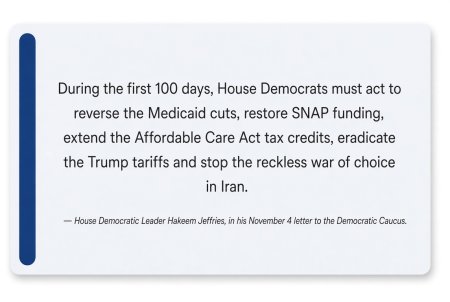
We expect negotiations around tariff policy between Congress and the White House. This promises to be a fascinating debate, held largely in the public eye. USTR no doubt will seek legislation that gives itself clear authority in exchange for commitments on where to use the revenue. Congress will push for reductions and sunsets on tariffs that are linked to consumer price increases. Solving for all the above will require nuance and detailed policymaking, but there will be motivation to do something. Businesses should pay very close attention.
Health Care. Democrats made health care a campaign issue as early as late 2025, when the Affordable Care Act tax credits were the holdout issue in the government shutdown. Restoring those credits will be central to their 2027 health care agenda, along with reversing the One Big Beautiful Bill’s Medicaid cuts and work requirements. Both are on the list for the first 100 days of the Democratic Congress. A White House veto will follow, but the negotiations that come after could put more federal money into health care. Markets have priced in that possibility: Medicaid-focused insurers and hospital operators rose sharply the day after the election.
Housing. Congress addressed housing supply earlier this year with the 21st Century ROAD to Housing Act, which passed with large bipartisan margins and changed the rules on permitting, manufactured housing and institutional ownership of single-family homes, among other things. However, there remains room for more action both at the federal and state levels. The bipartisan Build America Caucus has proposed a federal revolving loan fund for housing and other construction financing measures. Incoming Democratic senators have discussed a federally funded construction program. These are just the first round of ideas, and we should expect heavy amounts of policy whiteboarding in coming months. Whether it will be enough to move housing starts is the question. If so, the homebuilding supply chain, an important and significant part of the U.S. economy, will see growth in 2027 and 2028.
Theme #2: Data Centers and AI
Data Centers. The days of rapid and lightly regulated data center buildout appears to be over. Texas, the state whose leaders were most open to data centers, saw Democrats win every statewide office on the ballot. Governor-elect Gina Hinojosa ran on a promise to put a moratorium on all data center approvals. In Ohio, Sherrod Brown unseated Senator Jon Husted by calling him “the face of data centers.” The governors-elect in Ohio and Georgia ran on pauses or conditions.
Even states where Republicans retained control saw the data center theme affect campaigns. Utah Senate President Stuart Adams lost his June primary over a proposed data center project. Nationally, voters approved restrictions in 40 of 41 local data center ballot measures.
The moratoria and the slowdown that follows will have economic consequences. Goldman Sachs puts AI capital spending at 1.8 percent of GDP this year and 2.5 percent next year. Estimates of its share of quarterly GDP growth in 2026 range from a third to three quarters. Unless other commercial and home construction takes off, the economy could cool significantly.
AI Regulation. While the federal government has shown little interest in regulating AI, little has held the states back. Congressional attempts at a regulatory moratorium ended when the language was pulled from the One Big Beautiful Bill (and then again from the NDAA) under public pressure. The White House created a Justice Department task force to challenge state AI laws, but no state law has been displaced. States continue to pass and propose hundreds of AI-related bills.
What changes now? While AI regulation was not as prominent a campaign issue as data centers, the pace of AI development and its potential effects on jobs and public safety came up repeatedly. State legislatures will keep moving, and with Democrats gaining as many as a dozen chambers, the volume of bills will grow even more. In Congress, hearings on the AI buildout and model safety are likely, and they will add to the pressure for a national regulatory framework. Expect at a minimum a true, national policy debate about AI regulation.
Theme #3: Tax Policy
While many campaigns focused on tax breaks for the ultra-wealthy and corporations, translating these mostly general complaints into Congress’s tax priorities for 2027 is not straightforward. Some candidates returned to the carried interest loophole, which benefits fund managers, particularly in private equity. Others cited the “buy, borrow, die” strategy, and more generally the argument that the One Big Beautiful Bill favored high earners and corporations over the middle class. Narrow bills addressing some of these will no doubt be filed, but don’t expect them to get far on their own. Instead, expect a long and hard-fought budget process in 2027 in which many items will be on the table. Most significant for businesses would be if the 21 percent corporate rate and the One Big Beautiful Bill’s permanent 100 percent bonus depreciation are pared back. Each support capital spending and investment into U.S. businesses. Even modest adjustments to these core pillars would upend long-term growth plans for many corporates.
Departing Thought
Planning is in fact the main concern for businesses. They can adapt so long as they can see far enough out. They care less about which party is in control and more about how the policy landscape might change, so that they can plan accordingly. These campaign themes are a good early indicator.