
.

Tech Policy

Post Election Policy Preview for Business: Affordability, Data Centers and Taxes

November 11, 2026

by Troy M. Keller

Download as a PDF

Share this page

For Corporate America, the sweeping victories for Democrats in the November 3 midterm elections are significant, less because of the wins and losses and more because of policy changes that are sure to follow. Elected officials from both parties will be interested in responding to the voter concerns through legislative and regulatory action. Many of these actions will be impactful for businesses. Here is a look-ahead of what may be coming, using some of the major campaign themes as indicators.

Theme #1: Affordability (Tariffs, Health Care, Housing)

Tariffs. Businesses have been dealing with dynamic tariff policy since early 2025. Not only has the White House strategy been unpredictable, in many cases it has relied on old and little used statutes, which has led to litigation and legal uncertainty. Collectively, this has upended supply chains and made “tariffs” a boardroom topic across corporate America.

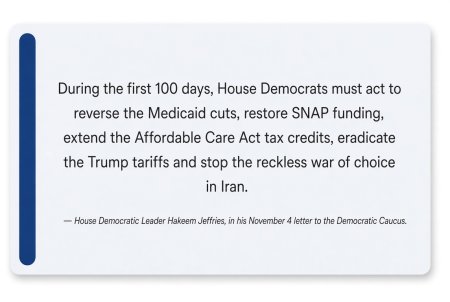
During the 2026 campaign, Democrats made headway treating tariffs as an affordability problem, and they have put tariffs high on the list of policies to push back on. Soon-to-be Speaker Hakeem Jeffries wants the House to “eradicate the Trump tariffs” in its first 100 days. Obviously, any change here would require White House agreement, and while an agreement to eradicate tariffs is no doubt off the table, there is the possibility of dealmaking. The day after the election, President Trump said in an interview that he could work with the Democrats and used as an example his opinion that he and Bernie Sanders were “identical on trade.” Within hours of that interview, Ambassador Greer cited it and posted from the USTR account the following: “Reindustrializing America has always been nonpartisan. I have ideas.”
We expect negotiations around tariff policy between Congress and the White House. This promises to be a fascinating debate, held largely in the public eye. USTR no doubt will seek legislation that gives itself clear authority in exchange for commitments on where to use the revenue. Congress will push for reductions and sunsets on tariffs that are linked to consumer price increases. Solving for all the above will require nuance and detailed policymaking, but there will be motivation to do something. Businesses should pay very close attention.

Health Care. Democrats made health care a campaign issue as early as late 2025, when the Affordable Care Act tax credits were the holdout issue in the government shutdown. Restoring those credits will be central to their 2027 health care agenda, along with reversing the One Big Beautiful Bill’s Medicaid cuts and work requirements. Both are on the list for the first 100 days of the Democratic Congress. A White House veto will follow, but the negotiations that come after could put more federal money into health care. Markets have priced in that possibility: Medicaid-focused insurers and hospital operators rose sharply the day after the election.

Housing. Congress addressed housing supply earlier this year with the 21st Century ROAD to Housing Act, which passed with large bipartisan margins and changed the rules on permitting, manufactured housing and institutional ownership of single-family homes, among other things. However, there remains room for more action both at the federal and state levels. The bipartisan Build America Caucus has proposed a federal revolving loan fund for housing and other construction financing measures. Incoming Democratic senators have discussed a federally funded construction program. These are just the first round of ideas, and we should expect heavy amounts of policy whiteboarding in coming months. Whether it will be enough to move housing starts is the question. If so, the homebuilding supply chain, an important and significant part of the U.S. economy, will see growth in 2027 and 2028.

Theme #2: Data Centers and AI

Data Centers. The days of rapid and lightly regulated data center buildout appears to be over. Texas, the state whose leaders were most open to data centers, saw Democrats win every statewide office on the ballot. Governor-elect Gina Hinojosa ran on a promise to put a moratorium on all data center approvals. In Ohio, Sherrod Brown unseated Senator Jon Husted by calling him “the face of data centers.” The governors-elect in Ohio and Georgia ran on pauses or conditions.

Even states where Republicans retained control saw the data center theme affect campaigns. Utah Senate President Stuart Adams lost his June primary over a proposed data center project. Nationally, voters approved restrictions in 40 of 41 local data center ballot measures.

The moratoria and the slowdown that follows will have economic consequences. Goldman Sachs puts AI capital spending at 1.8 percent of GDP this year and 2.5 percent next year. Estimates of its share of quarterly GDP growth in 2026 range from a third to three quarters. Unless other commercial and home construction takes off, the economy could cool significantly.

AI Regulation. While the federal government has shown little interest in regulating AI, little has held the states back. Congressional attempts at a regulatory moratorium ended when the language was pulled from the One Big Beautiful Bill (and then again from the NDAA) under public pressure. The White House created a Justice Department task force to challenge state AI laws, but no state law has been displaced. States continue to pass and propose hundreds of AI-related bills.

What changes now? While AI regulation was not as prominent a campaign issue as data centers, the pace of AI development and its potential effects on jobs and public safety came up repeatedly. State legislatures will keep moving, and with Democrats gaining as many as a dozen chambers, the volume of bills will grow even more. In Congress, hearings on the AI buildout and model safety are likely, and they will add to the pressure for a national regulatory framework. Expect at a minimum a true, national policy debate about AI regulation.

Theme #3: Tax Policy

While many campaigns focused on tax breaks for the ultra-wealthy and corporations, translating these mostly general complaints into Congress’s tax priorities for 2027 is not straightforward. Some candidates returned to the carried interest loophole, which benefits fund managers, particularly in private equity. Others cited the “buy, borrow, die” strategy, and more generally the argument that the One Big Beautiful Bill favored high earners and corporations over the middle class. Narrow bills addressing some of these will no doubt be filed, but don’t expect them to get far on their own. Instead, expect a long and hard-fought budget process in 2027 in which many items will be on the table. Most significant for businesses would be if the 21 percent corporate rate and the One Big Beautiful Bill’s permanent 100 percent bonus depreciation are pared back.  Each support capital spending and investment into U.S. businesses. Even modest adjustments to these core pillars would upend long-term growth plans for many corporates.

Departing Thought

Planning is in fact the main concern for businesses. They can adapt so long as they can see far enough out. They care less about which party is in control and more about how the policy landscape might change, so that they can plan accordingly. These campaign themes are a good early indicator.

Related Categories:

Tech Policy

Firm Highlights

Insights

Minnesota Consumer-Fraud Enforcement: Disclaimers Won’t Cure Deception, and Penalties Can Add Up

Misleading advertising claims can lead to costly consequences. In State of Minnesota ex rel. Ellison v. Wall & Associates, Inc., No. A25-2064, 2026 WL 3118291 (Minn. App. Oct. 19, 2026), the Minnesota Court of Appeals recently affirmed a bench trial verdict against a tax-relief company and two executives for violations of the Minnesota Consumer Fraud Act (“MCFA”) and the Minnesota Deceptive Trade Practices Act (“MDTPA”). The decision, which affirmed a substantial restitution and civil penalty judgment, underscores the broad power of the Minnesota Attorney General to act against deceptive sales practices. The decision also offers practical lessons for businesses seeking to reduce liability risks in consumer-facing communications. Background Wall & Associates (“W&A”), a Virginia-based tax-relief company, marketed assistance to taxpayers seeking relief from outstanding federal and state tax liabilities, often with offers in compromise—agreements to settle tax liabilities for less than the amount owed. In its extensive advertising campaigns, W&A represented that its average client received a 90% reduction in their tax debt, that it was a local company with Minnesota offices, that it provided legal services, and that it would “Solve ALL Tax Problems.” In reality, W&A’s promises bore little resemblance to what many clients received. Most of W&A’s clients saw just a 9.5% reduction in federal tax debt and 1.2% in state tax debt. W&A had no permanent Minnesota offices. And W&A provided neither legal representation nor assistance with filing tax returns—those services required referrals to separate firms for an additional fee. All the while, W&A clients paid upfront and recurring fees, including during periods when W&A did no work on their cases. Minnesota Attorney General Keith Ellison sued W&A, its founder and owner Ernest Kenneth Wall, and its president and CEO Patrick Mark Yates, alleging violations of, among other laws, the MCFA and the MDTPA. Following a 12-day bench trial, the district court determined that W&A violated the MCFA and MDTPA through its false and embellished advertising. The district court also held Wall and Yates individually liable for those violations because they directed, participated in, and acquiesced in the violations. The district court ordered injunctive relief, $2.7 million in restitution (with Wall and Yates jointly and severally liable for $1.3 million), and civil penalties of $786,517 against W&A, $415,500 against Wall, and $207,750 against Yates. The district court also awarded over $2.5 million in attorneys’ fees and costs to the state. W&A, Wall, and Yates appealed to the Minnesota Court of Appeals, which affirmed the district court’s decision on October 19, 2026. Although W&A, Wall, and Yates challenged the judgment on numerous grounds, several highlights of the decision provide important takeaways for consumer-facing businesses. Individual Reliance Is Not Required for Statutory Liability W&A argued that Attorney General Ellison had to prove a causal nexus between each violation of the MCFA and MDTPA and the injury to a particular consumer to establish liability. In W&A’s view, this required proof that each injured consumer had personally relied on W&A’s false representation. The Court of Appeals rejected this argument based on the MCFA’s and MDTPA’s plain language, which requires no proof of actual deception or confusion by consumers. The Court of Appeals finally pointed to the Minnesota Supreme Court’s decision in State v. Minnesota School of Business, Inc., which held that when a defendant’s misrepresentations are directed at and affected “a broad group of consumers, proof of direct individual reliance is not required to establish a causal nexus between MCFA violations and the harm suffered by consumers.” 935 N.W.2d 124, 135 (Minn. 2019). The Court of Appeals affirmed, however, that a causal nexus is necessary to support an award of damages under the MCFA and MDTPA. In making that determination, district courts look to various factors, including whether the misrepresentations were “longstanding, pervasive, and widespread in communications directed to consumers,” whether the seller intended and understood that consumers would rely on the misrepresentations, and whether the information was of a kind on which consumers would typically rely. The Court of Appeals’ decision continues Minnesota School of Business’s broad interpretation of liability under the MCFA and the MDTPA. Coordinated marketing campaigns to a “broad group of consumers” may expose businesses to MCFA and MDTPA liability without customer-by-customer proof of injury. That said, a causal nexus remains an element of an MCFA and MDTPA claim, and businesses involved in litigation should build a clear record at trial and on appeal showing how each of the relevant factors bears on the causal-nexus inquiry. Contractual Disclaimers Are Not an Automatic Defense to a Misleading Pitch W&A next argued that disclaimers in its client contracts prevented consumers from claiming they had been misled by its advertising. Reiterating that individual reliance is not required under the MCFA and MDTPA, the Court of Appeals held that a contractual disclaimer does not necessarily defeat a claim based on a conflicting oral representation. And on the facts of this case, the Court of Appeals agreed with the district court that W&A’s contractual disclaimers were insufficient given the extensive misrepresentations by W&A and the unequal bargaining power between it and its customers. This holding confirms that contractual disclaimers are not a cure-all for misleading advertising or sales practices. Businesses should review the entire customer journey, including pre-contract representations, as those representations may survive a contractual disclaimer to the contrary. And if faced with litigation, businesses should build a strong record, both at trial and on appeal, showing why any disclaimer is effective in context. The State Has Broad Authority to Seek Restitution W&A also challenged Attorney General Ellison’s authority to seek restitution under the state’s parens patriae authority to protect residents’ collective interests, arguing that injury to only 228 Minnesotans did not affect a sufficiently substantial segment of the population. The Court of Appeals rejected a simple headcount approach, instead explaining that the state had a legitimate interest in protecting residents’ economic well-being as a whole. In any event, the Court of Appeals held that if restitution was not appropriate under the state’s parens patriae authority, then it would still be appropriate under the Attorney General’s enforcement powers under Minn. Stat. § 8.31. The decision reinforces that the broader and more sustained the deceptive advertising, the stronger the case for restitution to protect Minnesotans’ economic interests. Civil Penalties Accrue Per Violation, Not Per Defendant The Court of Appeals finally rejected W&A’s claim that the Attorney General’s enforcement powers under Minn. Stat. § 8.31 permit only civil penalties of up to $25,000 for each defendant. Rather, the Court of Appeals explained that penalties are limited to $25,000 per violation. Multiple violations can therefore produce substantially greater penalties. The Court of Appeals also rejected the argument that restitution made penalties unnecessary: repaying consumers does not eliminate the need to address gains from deceptive conduct and deter future violations. Final Takeaways Align every consumer-facing communication. Broad and extensive marketing campaigns can expose businesses to stronger enforcement standards under the MCFA and MDTPA, making it critical that consumer communications remain accurate and consistent from the first advertisement through the final sale. Plan for layered enforcement exposure. Penalties under the MCFA and MDTPA can add up quickly: W&A, Wall, and Yates ultimately faced more than $6 million in civil penalties, restitution, and attorneys’ fees. The decision continues a line of Minnesota cases recognizing the Attorney General’s broad consumer-protection authority. Details matter. Although the Attorney General’s enforcement power is broad, it is not boundless. As the Court of Appeals explained, issues of causation, the effectiveness of contractual disclaimers, and the availability of restitution and civil penalties all turn on the specific facts of the case. Effective advocacy at trial and on appeal is critical to developing the facts relevant to liability and damages.